
Quantitative Investment Management and Systematic Trading
Two Sigma
Two Sigma manages investments and conducts systematic trading using data science, machine learning and distributed computing. Its investment management business researches market signals, constructs portfolios and executes trades across diversified global strategies for clients. Two Sigma Securities provides liquidity in equity, futures and ETF markets, trades options, and offers clients wholesale market making, algorithmic trading services and a single-dealer platform.
Founded in 2001 by David Siegel and John Overdeck, both co-founders and co-chairmen, Two Sigma combines investment research with engineering. Its researchers turn observations—from price movements to company news and retail activity—into predictive features, testing hypotheses rather than simply accumulating data. Its features research explores how large language models can generate additional textual datasets and reduce the work needed to investigate new signals. Internally, treating data as code brings version control, automated quality tests and reproducible processing to data pipelines.
The firm's proprietary data management system draws on more than 10,000 data sources. Two Sigma Real Estate extends its approach to real estate private equity, combining investment professionals with data scientists to identify markets and test investment hypotheses, primarily across North America. In 2026, Solovis acquired Venn from Two Sigma, transferring the multi-asset portfolio analytics, modeling and scenario-analysis platform.
Explore the recordings
This brand-level archive contains one recording credited to Two Sigma: Shu Fang’s talk on employee-linked enterprise agents. The recording does not identify a specific Two Sigma legal entity. The retained company background describes Two Sigma Investments separately; it does not establish that affiliation for this talk. The paths below highlight different parts of the recording. Technical details and deployment descriptions reflect Fang’s account at the time of the talk; they do not establish current architecture or product status.
Start with agent identity and permissions
Watch Tethered: Our Agents Are Us for Fang’s rationale for running agents under an employee’s identity. He describes problems with separate machine identities—including permission synchronization, duplicate licensing, and data-access incompatibilities—and an alternative using per-user Kubernetes namespaces and a sidecar that mounts identity material. This is a useful starting point for understanding the architecture and its permission model.
Follow the security and attribution tradeoffs
Return to the same recording for the consequences of sharing an identity: distinguishing human actions from agent actions and controlling agents’ access to the web. Fang describes a propagated provenance header and web access routed through Google’s Web Grounding for Enterprise, with native search and fetch tools denied. His reported freshness limits—roughly 24 hours generally and six hours for frequently updated sites—frame the tradeoff between access and external-egress risk. These are recorded claims, not independently verified present-day guarantees.
Finish with deployment practice and open questions
Use the closing discussion and Q&A in Fang’s talk to explore managed remote agents, employee-deployed agents, and production-support and security review. Fang also clarifies that provenance headers supplement authenticated identity and expresses personal interest in self-managed open-weight models for cost and stability. Treat that interest as his stated preference, rather than an organizational commitment or evidence of a current model deployment.
1 talk
Newest first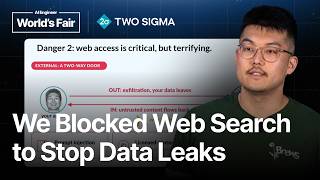
1 speaker at AIE
Affiliations reflect their AIE appearances, not necessarily current employment.