Armanas Povilionis is chief technology officer of Alithea Bio, where he leads AI and technology infrastructure for biotechnology research in immunopeptidomics and immunotherapy. He created Froglet, an open-source protocol that enables autonomous agents to commission external services and document their transactions across organizational boundaries.
Earlier in his career, Povilionis worked with Xigme on PICASO, a European initiative for coordinating healthcare across institutions while protecting sensitive patient information. His contributions covered identity management, access controls, privacy, and trust; he also coauthored a clinical study of distributed rheumatoid-arthritis care.
At Alithea Bio, Povilionis applies those concerns to collaborative scientific research, where specialized data, analytical methods, and computational resources are controlled by different organizations. His approach centers on three ideas:
Scientific automation requires cross-organizational coordination. Adding tools to individual agents does not solve the challenge of discovering external resources, negotiating access, commissioning specialized work, and preserving research provenance.
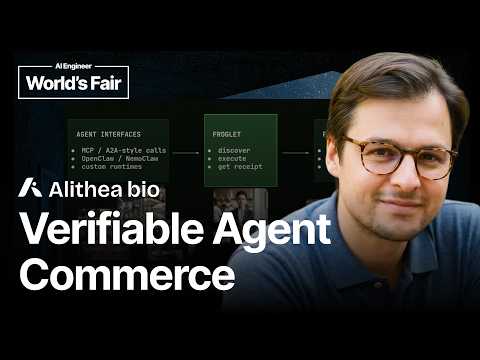
Verifiable agent-to-agent transactions make collaboration auditable.Froglet uses cryptographic identities and signed service descriptions, offers, quotes, deals, invoices, and receipts. Requesters, providers, and marketplaces share one node architecture; once a service is discovered, requester and provider transact directly. An initial charge protects providers, while a success fee protects requesters.
Agents need budgets, interoperability, and portable proof. Povilionis envisions agents purchasing metered database access, external computation, and specialist analysis across different payment systems and execution environments. Model Context Protocol integration allows tools including Claude to publish and invoke services, while his public account of Froglet emphasizes signed deals and verifiable receipts. A working demonstration shows a Docker-hosted node completing an auditable service transaction.
Froglet’s remote and local addition demos show how agents can discover external services, request work, and retain signed records across organizational boundaries.
Scientific agents need a way to procure work across organizations and retain evidence of what happened. Froglet proposes a shared interface for discovery, transactions, and signed receipts.
 ▶ Watch ↗
 ▶ Watch ↗