Bilge Yücel is a senior developer relations engineer at deepset and a contributor to Haystack, the open-source framework for building search, retrieval-augmented generation, and AI agents. She develops practical approaches to multimodal retrieval, agent safety, and sovereign AI: systems whose data, models, infrastructure, and operations remain under meaningful organizational control.
Yücel worked as a web developer at Hipo before earning a master’s degree in artificial intelligence at KU Leuven, where she focused on natural language processing. She joined deepset as a developer-advocacy intern and became a full-time developer advocate, combining software development with tutorials, live coding, open-source community support, and technical education. She later advanced to senior developer relations engineer.
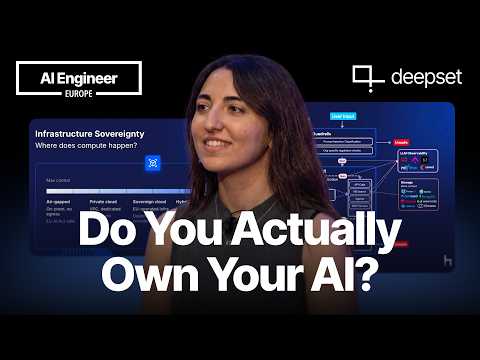
Sovereignty across the entire AI stack. Yücel distinguishes four operational concerns: where data is processed, whether models can be replaced, who controls computing infrastructure, and whether systems remain observable and auditable. Her AI Engineer Europe session identifies concrete failure modes: embedding APIs that move sensitive information across jurisdictions, model-provider lock-in, unexpected CPU/GPU and Kubernetes requirements, and incident response dependent on outside vendors. She treats sovereignty as a spectrum calibrated to organizational risk.
Model-agnostic orchestration and accountable agents. Her Haystack architectures combine explicit data flows, interchangeable models, versioned YAML pipelines, OpenTelemetry-compatible tracing, input and output guardrails, and human approval for consequential actions. She uses locally hosted Model Context Protocol tools and BM25-based tool discovery to expose relevant capabilities without overwhelming an agent’s context window.
Retrieval complexity that earns its keep. Yücel compares agent-driven retrieval with conventional pipelines using latency, accuracy, robustness, and traceability; autonomous search becomes useful when requests are ambiguous, tasks require multiple steps, or available tools change dynamically. An Intel agent-building guide demonstrates her practical use of document retrieval, web search, external APIs, and open models.
Multimodal retrieval across a shared vector space.Writing with Stefano Fiorucci, she shows how text, images, video, audio, and PDFs can support cross-modal search. Her multimodal agent workshop extends those ideas into agents with image understanding, document retrieval, conversational memory, and human-in-the-loop controls.
Sovereignty becomes an engineering problem when you must control where data moves, replace models, operate infrastructure, and explain what an agent did.
What does it mean to operate AI on your own terms?
 ▶ Watch ↗