← All speakers

Charlie Guo is a developer experience engineer at OpenAI, the founder of Artificial Ignorance, and a former startup founder who builds and explains practical AI systems. His work centers on helping software engineers make language-model applications accurate, auditable, affordable, and genuinely useful.

Guo studied computer science at Stanford and founded startups supported by Y Combinator, 500 Startups, and StartX. His early projects included an open-source Python interface for Gmail; in a 2015 essay for Wired, he examined the difficulty of finding product-market fit after attending Y Combinator. He also wrote Unscalable, a book about unconventional startup growth, and spent much of the following decade working on a creator-economy and e-commerce business.

He launched Artificial Ignorance in 2023, using regular experiments and technical writing to teach himself generative AI. That work helped him become a staff AI engineer at Pulley, where he built internal applications around frontier models.

In January 2026, Guo joined OpenAI’s Developer Experience team, helping developers learn and build with its technology. His educational interests include bringing ChatGPT Pro and Codex workshops to Stanford mathematicians.
  • Evidence-backed customer intelligence. At Pulley, Guo analyzed 10,000 sales-call transcripts in two weeks to sharpen customer profiles. When cheaper models confused incidental remarks with genuine customer characteristics, he selected Claude 3.5 Sonnet and combined retrieval, structured outputs and source citations to make classifications inspectable. The project became an internal customer-intelligence application with search, filters, and exports, as detailed in his AI Engineer talk.
  • Quality and cost are joint design constraints. Stronger models improved reliability but increased expense. Guo used prompt caching and longer single-pass outputs to reduce the transcript-analysis cost from approximately $5,000 to $500, demonstrating how model selection, data architecture, and conventional software engineering determine whether AI applications remain economically practical.
  • Evaluate models against actual work. Guo advocates workflow-specific model evaluations built from representative prompts, concrete tasks, and meaningful success criteria. His writing on custom benchmarks distinguishes behavioral, domain-specific, and product-focused testing from generic leaderboard scores that may conceal contamination or fail to predict real-world performance.

Read the topics behind these talks

2 conference talks

Key ideas

Scroll to read ↓

Charlie Guo’s customer research project at Pulley shows how model selection, traceable extraction, prompt caching, and a reusable interface turn a transcript archive into a working research tool.

  • The two-week analysis challenge
    0:04 ↗
  • From a broad ICP to specific customer evidence
    1:01 ↗
  • Choose the model against consequential errors
    3:12 ↗
  • Make extracted findings traceable
    4:13 ↗
  • Reduce repeated input work and split outputs
    5:18 ↗
  • The research infrastructure reaches other teams
    6:22 ↗
  • Build the system around the model
    7:18 ↗
  • Make customer research a repeatable operation
    8:19 ↗

Key ideas

Scroll to read ↓

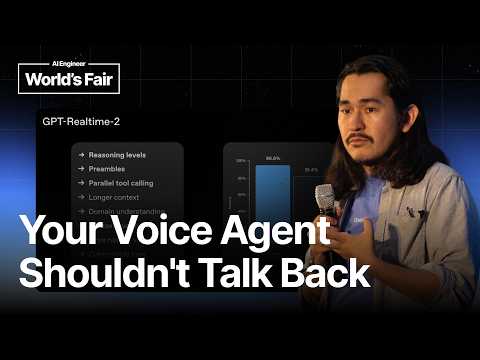
Charlie Guo of OpenAI reframes voice as an input and attention channel, not a requirement to answer aloud: an agent can converse, invoke application tools, update the interface, or speak only when an event deserves interruption.

  • Speech input does not require speech output. A voice request can produce conversation, tool execution, or visible interface feedback.
    0:48 ↗
  • Existing application verbs—such as API endpoints and React hooks—offer a practical route to voice control, but callable tools still require guardrails and safety checks.
    6:35 ↗
  • Use event-driven speech selectively. Animation and popups can handle lower-priority events; audio belongs higher in the escalation path because it interrupts attention.
    8:18 ↗
  • Native audio preserves acoustic and timing context that transcription can discard, while reasoning and tool calls still add latency.
    10:41 ↗
  • GPT Realtime-2 adds reasoning and parallel tool calls to audio interactions in Guo’s account; preambles explain the resulting wait rather than removing it.
    12:29 ↗
  • Design voice by deciding what the model perceives, which actions it may take, when it should communicate, and whether the response should be audible or visual.
    14:23 ↗

References