Diogo Almeida is co-founder and chief executive of TypeSafe AI, the company behind Jev, a model built to return typed decisions that software can use directly. He announced Jev on September 15, 2026, after two years in stealth. Previously a researcher at Google Brain and OpenAI, he helped develop the human-feedback techniques behind modern conversational AI—and now argues that those techniques also constrain what AI can accomplish independently.
Almeida coauthored research on learned optimizers that adapt optimization hyperparameters across unfamiliar machine-learning tasks. At OpenAI, he contributed to InstructGPT, whose foundational 2022 paper combined human demonstrations, preference rankings, and reinforcement learning to improve instruction-following. Human evaluators preferred its 1.3-billion-parameter model over a 175-billion-parameter GPT-3 baseline, demonstrating that targeted post-training could outweigh sheer model size.
He was also acknowledged among the contributors to ChatGPT and coauthored the GPT-4 technical report. His criticism of reinforcement learning from human feedback, or RLHF, emerges from firsthand involvement in establishing its effectiveness.
What comes after human-feedback training
Almeida identifies a mismatch between exceptional benchmark results and AI’s limited ability to handle expensive operational decisions. His AI Engineer World’s Fair talk develops four related arguments:
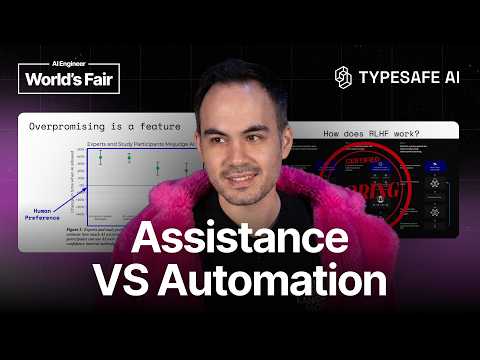
Assistance versus automation: RLHF rewards responses that satisfy an attentive person, producing useful collaborators without necessarily preparing models to execute unsupervised work reliably.
Reward-model asymmetry: Preference optimization can penalize visible uncertainty more readily than confident mistakes, encouraging hallucinations, overconfidence, and the suppression of plausible alternatives.
Calibrated decision-making: Neither human preference nor verifiable correctness alone defines good autonomous behavior; models must align confidence and action with the actual stakes of each decision.
Automation-native software: AI should expand what software can accomplish directly, instead of remaining a chatbot attached to existing applications or merely reducing the cost of writing conventional code.
Almeida also argues that excessive on-policy reinforcement learning can weaken tool use outside familiar settings, undermining practical engineering techniques such as decomposition, abstraction, and state management, as he described in a public post about tool-use reliability.
Jev: decisions inside software
Jev gives Almeida’s automation thesis a concrete interface. Developers send state and typed questions; the model returns structured values and probability distributions instead of generated text. The API exposes Choice for selecting among options, Score for evaluating a rubric, and Noul for estimating whether a statement is true. Choice and Score also return confidence, allowing code to decide when to act or defer.
TypeSafe calls this model family System One Models and its training method Reinforcement Learning for Calibrated Decisions (RLCD). Almeida’s launch post describes a new architecture and parallel sampler aimed at making intelligence practical inside ordinary software. Typed outputs constrain what the model can return; the confidence documentation explains how uncertainty guides action. Decision accuracy still needs evaluation on the application’s own tasks.
His World’s Fair 2026 recording predates Jev’s launch. Originally titled What’s next after RLHF?, it sets out the assistance-versus-automation argument while TypeSafe is still preparing its release. The later product supplies context for that research direction; its launch claims are separate from the evidence presented in the talk.
RLHF helped make language models useful assistants. Dependable automation asks for a different target: correct, calibrated decisions that software can use without continual supervision.

 ▶ Watch ↗