Eno Reyes is the co-founder and chief technology officer of Factory, where he builds autonomous software engineering systems that carry work from planning through implementation, validation, and deployment. His central insight is that reliable autonomy depends as much on organizational context and verifiable engineering environments as on model capability.
Raised in Atlanta, Reyes graduated from Princeton University in 2021 and worked at Microsoft and Hugging Face before founding Factory with fellow Princeton alumnus Matan Grinberg in 2023. The pair connected at a San Francisco hackathon, built an early autonomous coding demonstration, and attracted backing from Sequoia Capital. They were subsequently named to the 2025 Forbes 30 Under 30 list in artificial intelligence. Reyes has described his experience with fragmented tools, technical debt, and scattered institutional knowledge as formative to his approach.
Factory Droids: Reyes helped build agents for code review, documentation, testing, migrations, and feature development. Their architecture combines planning, explicit decision criteria, and environmental grounding: custom interfaces translate developer tools and noisy continuous-integration results into usable feedback. His approach to agent reliability weighs finer-grained planning against error propagation, additional inference against cost, and autonomy against human oversight.
Agent-ready codebases: Reyes argues that organizations should prioritize deterministic validation loops over marginal differences between coding-model benchmarks. Opinionated linters, reliable tests, documented interfaces, and OpenAPI specifications make generated changes mechanically verifiable, enabling specification-driven development, parallel agents, and larger modernization projects. His account of agent readiness describes a reinforcing cycle: stronger validation improves agents, which can then improve the engineering environment.
Organizational context: Effective agents need access to product requirements, design documents, customer feedback, incident histories, and runbooks—not only source code. Reyes envisions systems that clarify requirements, prepare validated pull requests, support planning, and investigate incidents using tools including Notion, Confluence, Jira, and Linear.
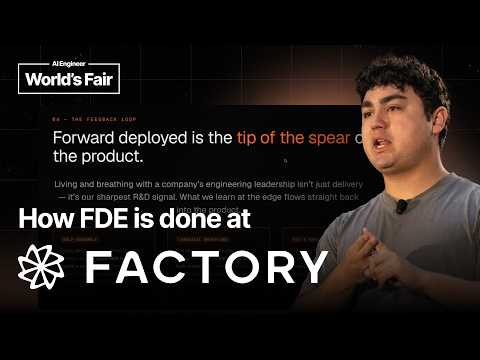
Software factories: In Factory’s next-stage strategy, co-written with Grinberg, Reyes connects customer signals to implementation, review, security checks, deployment, and operational feedback. His model requires enterprise governance, model independence, and organizational control over data. He positions forward-deployed engineering as a bridge between enterprise conditions and reusable product improvements, while engineers increasingly design, supervise, and refine the systems that build software.
Reliable software agents need plans that stay coherent, decisions that can be evaluated, and interfaces that turn environmental feedback into useful next actions.
Different software tasks need different agent architectures
Factory’s deployed engineers turn customer workflows into product improvements, with deterministic validation providing the foundation for increasingly autonomous software development.
What should an engineer embedded with a customer actually do?
Reliable coding agents need more than a good model: they need an environment that makes engineering standards explicit, executable, and easy to verify.
Delegating production work takes more than a coding agent: it requires shared context, collaborative planning, reliable validation, and clear responsibility for what agents do.