 ▶ Watch ↗
18:24

Conference affiliation: Contour Asset Management
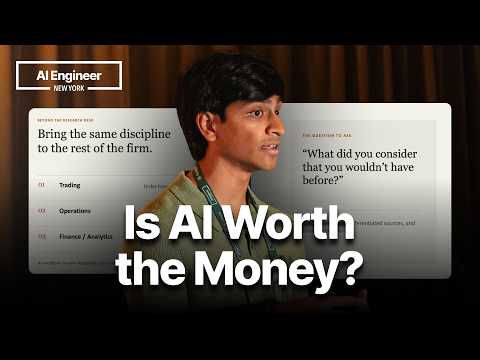
Hari Kumar is Head of AI and Data Science at Contour Asset Management, a long/short equity investment firm focused on technology, media and telecommunications. His work addresses a difficult measurement problem: how to tell whether AI improves investment research when an investment thesis may take months to affect returns.
Hari previously worked on Meta’s data science team, focusing on recommendation algorithms and growth prediction, and earlier in Boston Consulting Group’s technical enablement pillar. He earned a Master of Science in Engineering in Computer Science and a Bachelor of Science in Finance from the University of Pennsylvania. At Contour, his remit extends from analyst research to trading, operations and compliance.
Hari’s approach starts with the analyst’s actual work. At Contour, his team documents research workflows with and without AI: which sources analysts consult, what conclusions they reach and how much time the work takes. One comparison follows research on a company from one earnings report to the next. Another distinguishes between an agent conducting an expert interview and an agent also synthesizing the notes, allowing the team to compare how different divisions of work affect the analyst’s conclusions.
Faster research does not automatically produce a better investment. An analyst can reach a conclusion sooner without discovering anything useful, while a valuable insight may take months to affect returns. Hari describes the team’s cost per useful insight metric as a way to track time spent, tools used and ideas generated, then follow those ideas toward their eventual outcomes. His account of Contour’s AI work explains these process measures without reporting a quantified improvement in investment returns.
Hari identifies a second challenge in fundamental investing: analysts need to develop a thesis without becoming so attached to it that they discount new data or expert insights. The research tools he describes are intended to add evidence to an idea and help analysts reconsider it as circumstances change.
These efforts also shape the internal platform Contour is developing. Hari describes a system intended to accommodate individual analysts’ habits and financial models while drawing more value from existing data subscriptions. The aim is to bring information into the analyst’s working process instead of requiring separate visits to each provider’s portal.
Hari includes broken connectors, failed model calls, debugging and time spent learning tools in the cost of adoption. Those interruptions consume the same analyst attention that automation is supposed to free. Measuring time saved therefore also requires counting the time taken away from research to understand and maintain the tools.
His work beyond research follows a similar concern with how people spend their time. On the trading side, he describes using agents to track holdings and market developments so traders can contribute ideas as well as execute orders. In operations and compliance, Contour is working to bring tasks such as order reconciliation and vendor tracking into a shared tool, reducing the need to move between separate systems. These remain distinct parts of the AI mandate: improving the research process, making existing information more useful and reducing repetitive work across the firm.
▶ Watch ↗18:24
Loading more talks and highlights…