← All speakers

Bio, Work & Ideas

Kwindla Kramer

Conference affiliation: CEO · Daily · 2026

Kwindla Hultman Kramer is the co-founder and chief executive of Daily, the real-time communications company behind Pipecat, an open-source framework for conversational voice and multimodal applications. His career spans early web infrastructure, gesture-controlled spatial computing, and the real-time systems that make spoken interactions with AI practical.

Kramer began programming professionally during the early commercial web, building web servers, search systems, and publishing tools. He became the founding chief technology officer of AllAfrica, helping develop infrastructure for the African news organization.

In 2006, he co-founded Oblong Industries with John Underkoffler to commercialize spatial-interface concepts associated with Minority Report. As chief executive, he helped develop the g-speak Spatial Operating Environment, which combined gesture, multiple screens, and shared workspaces.

At Daily, Kramer extended that interest in unconventional interfaces into developer infrastructure for live audio, video, and AI. By 2023, he was building applications that combined speech recognition, language models, and synthesized voice. Daily and its open-source community developed Pipecat to orchestrate the audio pipelines, conversational context, model calls, interruptions, and provider integrations behind responsive voice applications.

  • Voice is an end-to-end systems problem. Useful conversational software depends on transport, transcription, inference, speech generation, and application state working together under tight latency constraints. Kramer emphasizes production evaluation and instruction-following accuracy over demonstrations that merely sound convincing.
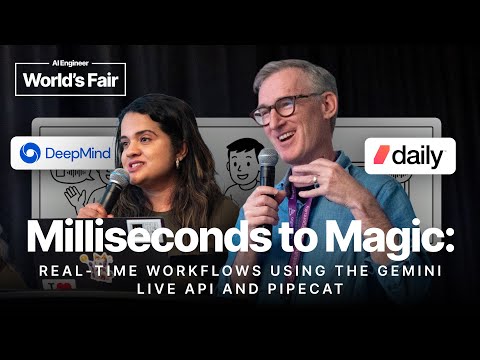
  • Turn detection moves down the stack. Kramer initially handled conversational timing in application code, then incorporated it into Pipecat; real-time model APIs increasingly absorb the same responsibility. His work with Google DeepMind on real-time voice workflows illustrates how interruptions, function calls, and changing interface state remain difficult even as the underlying infrastructure improves.
  • AI-native software extends beyond chat. Kramer treats today’s agents as foundational components for richer applications combining shared context, background subagents, dynamically generated interfaces, and conversational control. His Gradient Bang multiplayer game explores those patterns, while his local macOS voice-agent experiments investigate conversational systems running on personal computers.

Read the topics behind these talks

2 conference talks

Key ideas

Scroll to read ↓

A voice-driven personal assistant turns grocery lists, book requests, and animated cats into a practical exploration of turn detection, tool behavior, and conversational state.

  • What makes talking to a computer feel natural?
    0:00 ↗
  • Locate the responsibility, then assess its maturity
    2:57 ↗
  • Start with an asparagus-pizza grocery list
    6:53 ↗
  • When incidental speech becomes application state
    9:56 ↗
  • Adding a task is not the same as displaying it
    13:02 ↗
  • Grouping, duplication, and ownership
    14:14 ↗
  • Ask for an interface, not just another list
    15:57 ↗
  • What the application leaves for the model to infer
    17:16 ↗
  • Remembering what the reminder was for
    19:33 ↗

Key ideas

Scroll to read ↓

From Bush’s Memex to a multiplayer game built around LLMs, the path beyond agents depends on new ways to combine computation, context, interfaces, and human intent.

  • How do you imagine software before its infrastructure exists?
    0:24 ↗
  • From agent harnesses to something beyond agents
    2:03 ↗
  • Turning calculation into a dialogue
    4:57 ↗
  • The spreadsheet made a capability broadly accessible
    8:40 ↗
  • Knowledge Navigator put the pieces together
    10:42 ↗
  • A multimodal computer, connected and in your pocket
    12:17 ↗
  • Moving the interface into the surrounding world
    13:52 ↗
  • The infrastructure catches up with the vision
    17:10 ↗
  • A calendar conversation built with available technology
    18:04 ↗
  • Gradient Bang makes orchestration part of the game
    19:09 ↗

References