← All speakers

Bio, Work & Ideas

Liad Yosef

Conference affiliation: Erel Labs · 2026

Liad Yosef is the co-founder and chief technology officer of Ora, a co-creator and maintainer of MCP Apps, and a co-creator of GitMCP. He builds infrastructure that helps AI agents find and operate software while preserving the recognizable interfaces, specialized interactions, and human oversight that make applications useful.

From frontend architecture to the agentic web

Yosef previously worked as lead frontend architect at Duda, helping build its React-based website builder, before joining Shopify’s CEO office as a principal developer focused on agentic commerce and Model Context Protocol infrastructure. He also worked on AI and MCP in Monday.com’s CEO office.

His open-source projects include webpack-node-externals, which excludes Node.js dependencies from Webpack bundles, and ChatGPT-pdf, a browser extension for exporting conversations as PDFs, images, or shareable links. With Ido Salomon, he co-created GitMCP, which gives AI assistants direct access to documentation and context from public GitHub repositories through remote MCP servers.

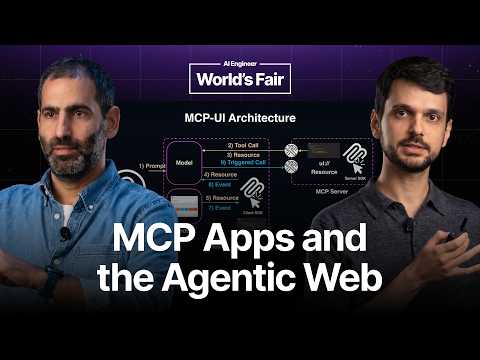
Yosef collaborated with Salomon on MCP-UI, originated by Salomon, and helped develop its concepts into MCP Apps, an official protocol extension for embedding interactive application interfaces inside AI assistants. He co-authors and maintains its specification and participates in its open working group.

At Ora, Yosef focuses on agent-readiness measurement: assessing whether agents can discover and successfully navigate websites and digital products. In August 2026, he announced Ora’s collaboration with Vercel on is-agentic.com, an Ora-powered tool for evaluating the agentic web.

  • Interfaces carry expertise and identity. Reducing established products to text discards familiar interaction patterns and useful visual context. MCP Apps lets an analytics service display an interactive funnel, or a commerce platform present recognizable purchasing controls, directly inside an assistant.
  • Host-mediated interaction preserves context and control. Applications render in sandboxed environments and relay interactions through their host, which can authorize tool calls, update conversational context, or determine the next action. Persistent views can also prevent demanding applications from repeatedly reloading complex interfaces.
  • Interoperability matters more than one rendering model. Yosef co-authored guidance on combining MCP Apps and Google’s A2UI, describing architectures that accommodate application-defined interfaces, host-rendered declarative components, and generated UI while balancing branding, security, and state synchronization.

Read the topics behind these talks

3 conference talks

Key ideas

Scroll to read ↓

MCP Apps lets services deliver recognizable interfaces inside an assistant, while the host coordinates interactions, tool calls, and the wider user journey.

  • Why should a service become a wall of text?
    0:18 ↗
  • From MCP-UI to a shared extension
    2:22 ↗
  • Deliver HTML, then let the host coordinate actions
    4:58 ↗
  • From funnel status to a clickable explanation
    6:35 ↗
  • The resource and callback loop
    8:46 ↗
  • Compose the task from pieces of services
    10:14 ↗
  • The host owns the wider journey
    12:25 ↗
  • Keep expensive views alive and let the host operate them
    14:16 ↗
  • One protocol across different ways of building UI
    15:29 ↗
  • An application distribution channel
    17:01 ↗

Key ideas

Scroll to read ↓

MCP Apps lets assistants present familiar interfaces, route interactions through the host, and compose services without reducing every tool result to text.

  • What disappears when a tool returns only text?
    0:46 ↗
  • From MCP-UI to MCP Apps
    2:04 ↗
  • A playlist needs both a view and an action path
    5:14 ↗
  • From a funnel report to interactive exploration
    6:48 ↗
  • The bidirectional implementation flow
    8:54 ↗
  • Compose the anniversary, not the websites
    10:23 ↗
  • How much control does the UI retain?
    12:34 ↗
  • Keeping up with the spec—and keeping views alive
    14:09 ↗
  • Predefined, declarative, or generated
    16:27 ↗
  • Assistants as an application distribution channel
    18:33 ↗
  • Build an app, integrate a host, or shape the standard
    19:15 ↗
  • Rethink the core application experience
    20:55 ↗

Key ideas

Scroll to read ↓

MCP Apps brings service interfaces into assistants. Liad Yosef explains how that changes product design, why published guidance can go unread, and what agents need to find and use the web.

  • MCP Apps lets a service return interactive UI inside a conversation, keeping human inspection and choice within an agent-led task.
    1:12 ↗
  • A personal assistant can carry context across services and compose the interface fragments relevant to one intent. Yosef’s anniversary flow illustrates the proposed architecture.
    4:11 ↗
  • Agent readiness includes understanding, interaction, authentication, and payment. Discovery alone does not establish that a task can be completed.
    11:13 ↗
  • Published guidance needs a route from the pages agents actually visit. ORA’s llms.txt observation supports that distinction, although the reported usage rate remains unclear.
    13:44 ↗
  • Compare the same site and intent across agent harnesses: different journeys can reveal resources that one environment finds and another overlooks.
    15:14 ↗
  • Provider catalogs describe available integrations; queryable directories help agents discover them. Successful use still requires its own observation.
    11:43 ↗
  • Human accessibility and agent accessibility overlap where software must communicate meaning and capabilities without relying on visual presentation.
    19:16 ↗

References