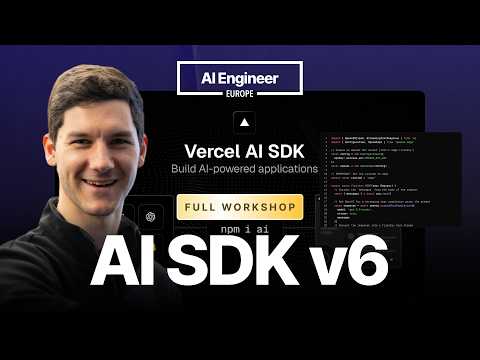
Nico Albanese is a member of technical staff at OpenAI working on the Codex app and the creator of Open Agents, an open-source system for running coding agents in the cloud. Previously, he helped build Vercel’s AI SDK, giving TypeScript developers practical tools for integrating language models, structured outputs, and autonomous workflows.
From venture investing to developer infrastructure
Albanese studied in a business program spanning the University of Southern California, the Hong Kong University of Science and Technology, and Bocconi University. After interning at the early-stage investment firm Ascension, he joined in 2018 and advanced from investment associate to investment principal. He also built Deal Flow OS, an open-source system for managing startup investment pipelines.
He subsequently created Kirimase, a command-line tool for scaffolding full-stack Next.js applications, which Vercel acquired. At Vercel, he helped develop the AI SDK as its weekly downloads grew from approximately 50,000 to 15 million. His work progressed from model-provider interoperability and typed application primitives toward persistent agents, isolated execution environments, and durable workflows.
Portable models, explicit tradeoffs. Albanese favors a common TypeScript interface for switching model providers while distinguishing custom tools from provider-executed capabilities. Hosted web search simplifies implementation, for example, but ties an application more closely to a particular model provider.
End-to-end type safety for agent applications. He treats an agent definition as the source of truth for tool schemas, runtime inputs, messages, streaming responses, and frontend interfaces, separating reusable agent logic from framework-specific request handlers.
Persistent filesystems for reliable agents. His agent-systems workshop demonstrates how isolated sandboxes give agents durable plans, research artifacts, reusable scripts, and straightforward Markdown-backed memory across requests.
Prompt-cache stability over premature compaction. Albanese warns that rewriting conversation history can invalidate cached prompt prefixes, while generated summaries can lose critical instructions. For longer tasks, he favors delegating bounded work to subagents that return concise results to the main context.
Cloud coding agents with durable execution.Open Agents combines isolated sandboxes, GitHub integration, model routing, and recoverable workflows so coding sessions can continue beyond a local terminal. Albanese announced its open-source release after using the system in his own development workflow.
His deep-research implementation illustrates the same engineering priorities: generate targeted queries, evaluate sources, pursue bounded follow-up questions, avoid duplicates, and synthesize a final report without repeatedly regenerating bulky search results. Now building the Codex app at OpenAI, Albanese applies that practical emphasis on persistent state, disciplined context management, and dependable execution to coding agents.
Build a streaming TypeScript agent, add typed tools and a persistent filesystem, then follow the live debugging that turns stored memories and scripts into reusable capabilities.
A simple text call grows into a Node.js research workflow with typed tools, relevance feedback, recursive searches, accumulated evidence, and Markdown report generation.