Richard Socher is the co-founder and chief executive of Recursive and the founder and chief executive of You.com. His career spans foundational natural-language-processing research, enterprise AI, search infrastructure for AI agents, and systems designed to automate scientific discovery.
After studying linguistic computer science in Germany, Socher earned a computer science PhD from Stanford in 2014 and later taught there as an adjunct professor. His research helped replace manually engineered linguistic features with representations learned by neural networks. He contributed to the Stanford Sentiment Treebank, co-developed GloVe word embeddings with Jeffrey Pennington and Christopher Manning, and co-authored research on contextualized word vectors with Bryan McCann, James Bradbury, and Caiming Xiong.
In 2014, Socher founded MetaMind to apply deep learning to practical products. Salesforce acquired the company in 2016, and he became its chief scientist and an executive vice president, helping establish its AI research organization and integrate deep learning across its software platform.
He subsequently founded You.com with McCann. The company developed web-scale search infrastructure for language models, providing AI systems with current, relevant information beyond the limited links and snippets of conventional search. Socher also co-founded AIX Ventures, where he serves as managing partner and has backed AI companies including Hugging Face and Weights & Biases.
Building machines that can improve research
At Recursive, which he co-founded with collaborators including Tim Rocktäschel, Socher is pursuing automated scientific discovery through several connected technical ideas:
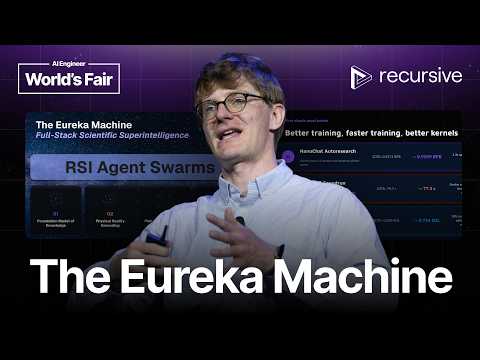
The Eureka machine: A proposed research architecture combining scientific literature, measurement data, simulations, and physical experiments. Coordinated AI agents would generate competing hypotheses, implement potential solutions, and test their conclusions against empirical evidence.
Recursive self-improvement: Socher distinguishes optimizing an external model or benchmark from an AI system identifying its own limitations and improving its training, research, and operational stack. He argues that AI’s growing ability to write and evaluate code makes this stronger form of self-improvement increasingly practical.
Search infrastructure for AI agents: Agents can process substantially more material than human readers, making information retrieval, freshness, and provenance essential to systems expected to investigate questions independently.
Empirical checks against reward hacking: Early experiments have targeted small-model training, faster language-model training, and NVIDIA GPU kernels, including techniques involving hashed bigram and trigram embeddings and learned gating. These results demonstrate bounded research automation; their usefulness depends on excluding benchmark loopholes and misleading performance gains.
His longer-term ambition is to extend these research systems beyond AI into fields including biology, chemistry, medicine, and physics.
Richard Socher’s Eureka machine begins with a practical loop: propose an idea, implement it, and test it—then use that loop to improve the machinery of AI research itself.

 ▶ Watch ↗