← All speakers

Bio, Work & Ideas

Thariq Shihipar

Conference affiliation: Claude Code · Anthropic · 2026

Thariq Shihipar is a member of technical staff at Anthropic working on Claude Code, where he develops the tools and interaction patterns that allow AI agents to investigate problems, clarify uncertainty and verify their work. Before joining Anthropic, he co-founded the academic publishing platform PubPub and led One More Multiverse, a Y Combinator-backed collaborative gaming company.

Shihipar began building startups while studying computer engineering at the University of Toronto. He co-founded Chime, a web-notification startup acquired by HubSpot in 2013, and subsequently worked at HubSpot before pursuing graduate studies at the MIT Media Lab.

At MIT, he and Travis Rich created PubPub, an open-source scholarly publishing platform combining collaborative editing, discussion, annotations and multimedia. He also developed NewsClouds, a news-visualization project, and later built Edgeout.gg, a gaming analytics platform acquired by Blitz.

With Hisham Bedri and illustrator Sara Alfageeh, Shihipar co-founded One More Multiverse, which developed browser-based tools for playing tabletop role-playing games in illustrated digital worlds. After winding down the company, he joined Anthropic’s Claude Code team.

Ideas shaping his approach to agents

  • Bash and the filesystem as an agent’s working environment. Shihipar favors giving agents flexible Unix primitives for searching files, composing APIs, writing scripts and preserving intermediate results. His Claude Agent SDK workshop applies this architecture to spreadsheets, email analysis and a Pokémon agent that combines competitive-game data with generated TypeScript.
  • Progressive context disclosure. Shihipar treats skills as folders of instructions, scripts and reference material that agents load when needed. His account of Claude Code skills describes capturing organizational expertise without burdening every interaction with every instruction.
  • Verification before trust. He prioritizes deterministic safeguards such as compilation, linting, explicit permission checks and rules preventing agents from modifying files they have not inspected. Sandboxing, scoped credentials, command inspection and independent review provide additional protection; reversible operations make mistakes easier to contain.
  • The Ask User Question tool. Shihipar introduced Claude Code’s structured question-asking tool to help agents resolve ambiguous requirements. His field guide to advanced coding agents extends that principle through blind-spot reviews, interactive HTML prototypes, implementation notes and quizzes that preserve human understanding.

He also advocates agent-ready software interfaces, arguing that companies can expose existing products to agents and charge for useful interactions. His experiments with illustrated explanation tools reflect the same practical priority: advanced AI should make difficult work more understandable while expanding what people can accomplish.

Talks by Thariq Shihipar

3 talks

Key ideas

Scroll to read ↓

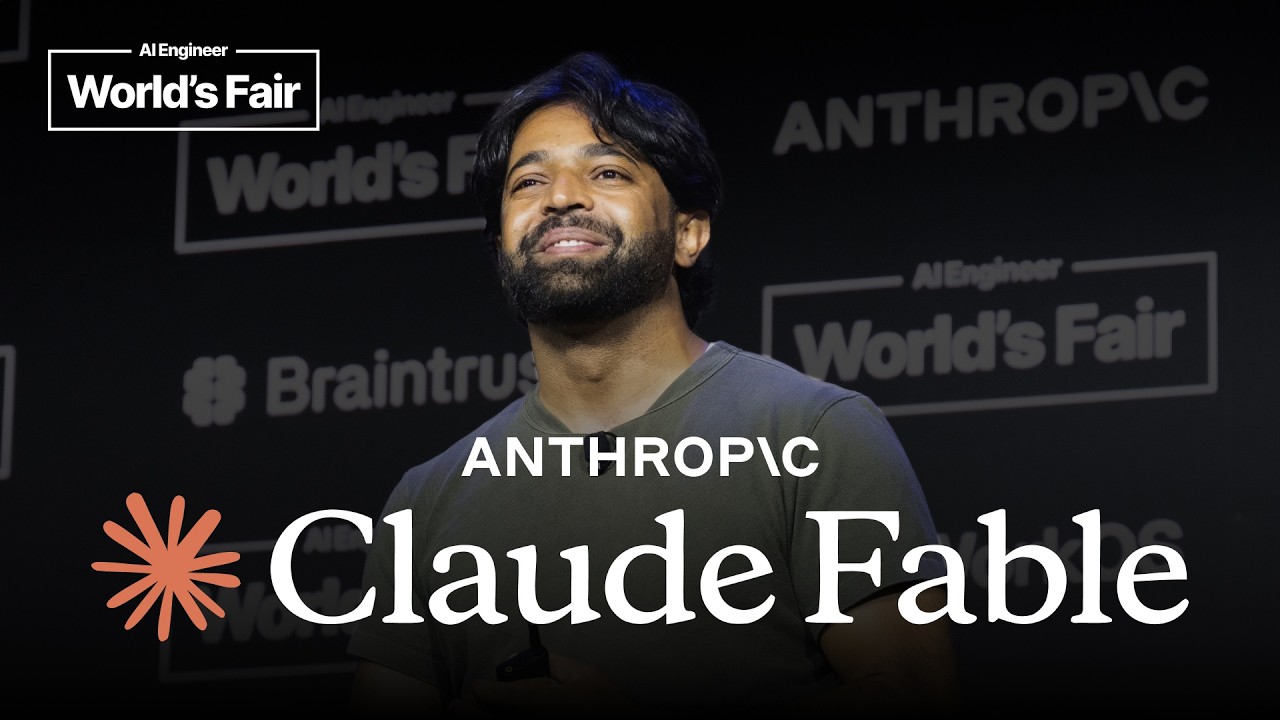
Thariq Shihipar explains how Fable changes agentic coding: better tools and lighter constraints expose latent capabilities, deliberate discovery keeps humans informed, and faster implementation makes ambitious work possible without making value creation automatic.

  • Capability overhang emerges when a model can accomplish more with the right harness, environmental access, and code execution than it can through unsupported conversation alone. 3:06 ↗ 4:13 ↗ 5:14 ↗
  • Reevaluate prompts and tools as models change: newer systems may benefit from fewer examples, fewer restrictive instructions, and more useful context. 5:14 ↗ 6:22 ↗
  • Use the map-versus-territory framework to distinguish explicit requirements, recognized uncertainties, unstated assumptions, and issues nobody has considered. 8:33 ↗ 9:34 ↗ 10:38 ↗
  • Surface missing information through blind spot passes, contrasting prototypes, targeted interviews, and concrete reference implementations. 10:38 ↗ 11:36 ↗ 12:39 ↗
  • Maintain human accountability with implementation notes that document unexpected decisions and follow-up quizzes that verify understanding before a PR is created or merged. 13:31 ↗
  • Challenge assumed engineering tradeoffs, but do not confuse faster building with value creation, which still requires experimentation and judgment. 15:39 ↗ 16:56 ↗ 18:08 ↗

Key ideas

Scroll to read ↓

Thariq Shihipar explains how the Claude Agent SDK builds on Claude Code, why files and Bash make agents more adaptable, and how to design systems that gather context, act safely, and verify their work.

  • Design agents around gathering context, taking action, and verifying work, while treating verification as a continuous property of the entire loop rather than a final checkbox. 21:41 ↗ 1:21:04 ↗ 1:21:54 ↗
  • Choose structured tools for controlled atomic actions, Bash for composable filesystem and command-line operations, and code generation for dynamic API composition, while accounting for their different context and latency costs. 25:12 ↗ 26:12 ↗ 27:08 ↗ 28:15 ↗
  • Make unfamiliar problems more accessible by exposing data through interfaces the model can already use, including spreadsheet ranges, SQL, searchable files, and progressively discoverable command-line scripts. 41:41 ↗ 55:34 ↗ 59:14 ↗ 1:01:26 ↗
  • Protect powerful agents with layered defenses, scoped credentials, sandboxing, deterministic checks, and reversible checkpoints instead of assuming the model alone will enforce application security. 13:03 ↗ 14:12 ↗ 46:55 ↗ 1:07:52 ↗ 1:10:36 ↗ 1:11:42 ↗
  • Control context growth by saving bulky outputs to files, delegating focused work to sub-agents, and reconstructing state from durable artifacts instead of repeatedly loading entire datasets or conversation histories. 29:45 ↗ 1:06:13 ↗ 1:07:05 ↗ 1:14:17 ↗ 1:15:39 ↗ 1:19:07 ↗
  • Prototype directly in Claude Code, inspect real execution transcripts, refine instructions and helper scripts, and only then package the working behavior behind a small SDK entry point. 21:41 ↗ 1:23:33 ↗ 1:24:29 ↗ 1:39:54 ↗ 1:48:38 ↗

Key ideas

Scroll to read ↓

Cat Wu, Thariq Shihipar, and Simon Willison explore how stronger coding agents change product judgment, team collaboration, review, prompting, and the security needed for sustained autonomy.

  • Fable returns, and expectations rise
    0:28 ↗
  • Product judgment and the economics of rewrites
    3:49 ↗
  • A shared agent inside the team’s conversation
    6:35 ↗
  • Let usage challenge product intuition
    11:35 ↗
  • Earn automated review one area at a time
    14:18 ↗
  • Evaluate both capability and behavior
    17:16 ↗
  • Give capable models context without overconstraining them
    20:19 ↗
  • Models write prompts, and prompts explain products
    25:28 ↗
  • Keep tools distinct, and preserve useful interfaces
    28:03 ↗
  • Auto Mode evaluates permission in context
    30:57 ↗
  • Shared agents need separate identities and protected secrets
    35:01 ↗
  • Find the larger project and fill the missing role
    37:53 ↗
  • An editing task that required judgment
    41:49 ↗
  • Following a specification is not the whole design task
    43:35 ↗
  • Make context accessible and test imagined trade-offs
    45:07 ↗
  • Eval quality and the concrete shape of shared memory
    49:20 ↗

References