# Content Is Code
Matt Palmer
AI Engineer World's Fair 2026
[Talk page](https://ai.engineer/talks/yv6xovSsB1U-content-is-code) · [Video](https://www.youtube.com/watch?v=yv6xovSsB1U)
## Content Is Code
AI makes code a practical medium for technical communication, but accurate changelogs, polished videos, and reusable content pipelines still depend on a carefully structured source of truth.
Basic familiarity with React components and pull requests is helpful for the code example and release workflow discussion.
### Choosing a medium
[0:00](https://www.youtube.com/watch?v=yv6xovSsB1U&t=0s)
Should this explanation be a blog post, a video, or a conference talk? The choice often follows the creator’s existing skills: writers write, video creators record, and speakers present. Code introduces another possibility—a medium for producing the assets through which an explanation travels. Matt Palmer frames its growing accessibility in 2026 as a departure from a world where creating content through code usually required a professional software engineer, whose time was mostly devoted to engineering.
**Technical communication explains what problem a product solves.** It includes documentation, changelogs, product marketing emails, video, and the broader work associated with developer relations, but anyone can do it. The standard is usefulness to the reader or viewer: documentation for a data access framework, for example, should accurately cover the whole framework, not merely introduce its most visible features.
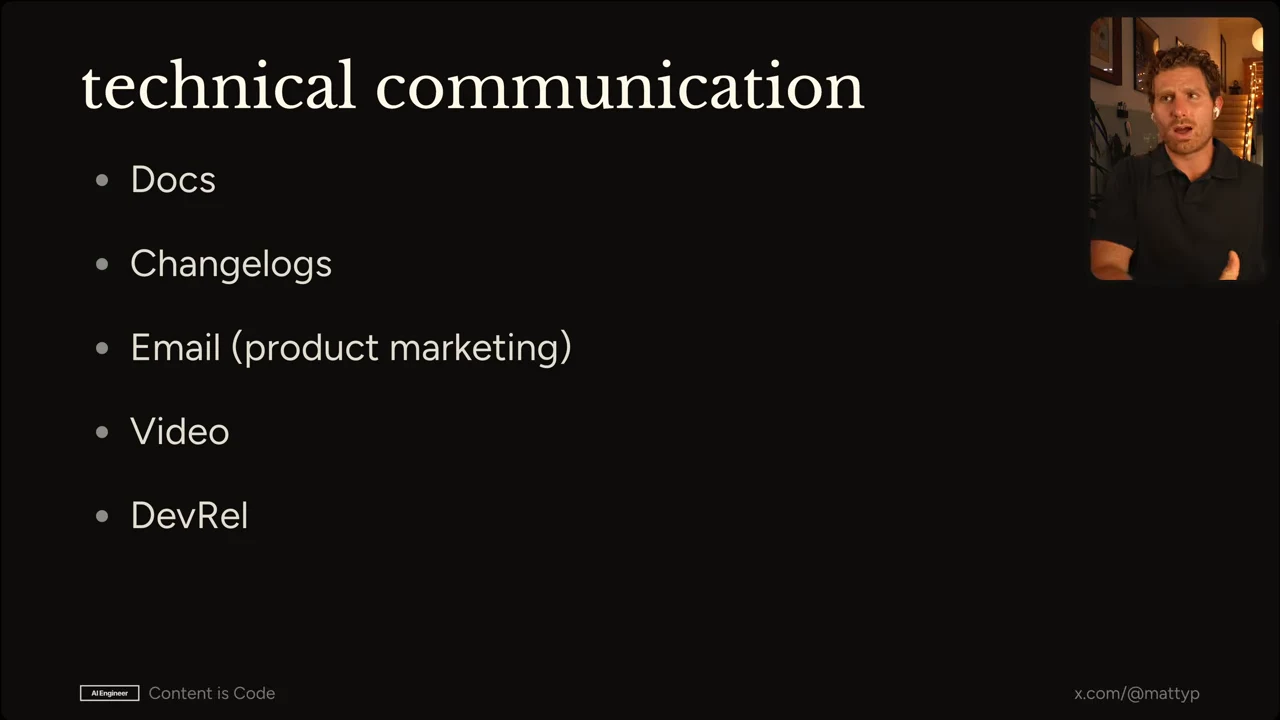
Technical communication spans docs, changelogs, product marketing email, video, and DevRel.
### A changelog starts with knowing what changed
[1:14](https://www.youtube.com/watch?v=yv6xovSsB1U&t=74s)
A timely changelog with useful supporting assets depends on something less visible: an accurate **product diff**. Before explaining a release, someone—or some system—must establish what actually changed. Without that foundation, the work falls to a person combing through pull requests to reconstruct what shipped. Writing the announcement is only the last part of the job.
Once the changes are understood, they can be summarized over a longer period in product updates and emails. The same communication problem also extends beyond text: a homepage can show a product tour instead of a static screenshot. These formats all explain what a product does or how it has changed, using written material, code, and distinct visual assets.
### Recreating a product surface in React
[2:09](https://www.youtube.com/watch?v=yv6xovSsB1U&t=129s)
Video overlays are a relatively small application of this approach: code supplies an engaging element inside a larger production. The next step is to build the entire demonstration in code. Palmer shows a tour of [Conductor](https://www.conductor.build/docs) made with React and [Remotion](https://www.remotion.dev/docs/the-fundamentals). He recreated the product surface inside a Remotion scene and used it to walk through a sample user flow. The result is an authored interface demonstration, not a screen recording of the live product.
Remotion’s frame-driven React model makes the mechanism concrete: a component can select the interface state to display from the current video frame. A minimal illustrative scene might move a sample workspace from a preparation screen to a review screen:
```tsx
import { AbsoluteFill, useCurrentFrame } from 'remotion';
export const WorkspaceTour = () => {
const frame = useCurrentFrame();
const reviewing = frame >= 90;
return (
{reviewing
? 'Inspect the proposed update before merging.'
: 'Describe the update you want to make.'}
);
};
```
Here, the frame changes the rendered scene; it does not execute a product operation. This is the basic distinction that lets a recreated interface become a controllable video asset.
Palmer describes his tour as a prototype: it is a little buggy, and the flows are not fully worked out. His expectation is that this kind of production will become normal. Coming from data engineering, then leading DevRel at Replit and, at the time of the talk, developer experience at Conductor, he describes the broader change as content **shifting left toward code as the source of truth**.
### From handcrafted assets to scarce engineering time
[3:07](https://www.youtube.com/watch?v=yv6xovSsB1U&t=187s)
Palmer divides content production into three eras: handcrafted assets, expensive code, and inexpensive AI-assisted code. In the handcrafted era, the available levers are time, money, and skill. You make the asset yourself or hire someone with the expertise you lack—an agency or a professional motion graphics creator, for example. Personal effort eventually runs into the limits of the working day.
In the second era, code and cloud infrastructure are mature, but engineering becomes the bottleneck. Palmer associates this with the zero-interest-rate, or ZIRP, period: organizations pay heavily for engineers, and producing sophisticated assets requires access to their time. The supplier changes from an agency to an engineer, while the dependency on scarce expertise remains.
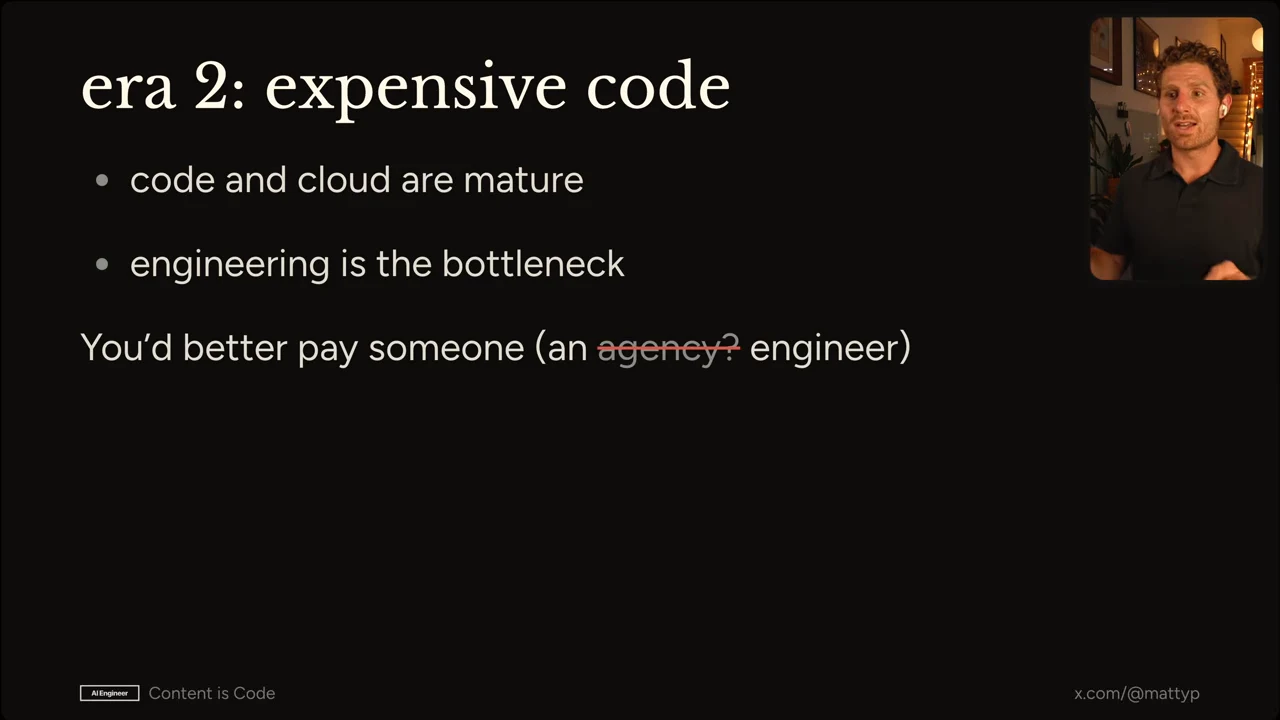
Expensive code makes engineering the bottleneck.
Robust documentation and polished websites compete with other engineering priorities. Palmer dismisses the earlier low-code website services as inadequate for the quality he wanted; in his account, a good website still needed a front-end engineer. That opportunity cost also explains his view of Remotion’s earlier limited adoption: the framework existed, but few people had both the time and the role of a content engineer. This is his explanation of the adoption pattern, rather than a measured usage history.
### TypeScript becomes a creative medium
[4:51](https://www.youtube.com/watch?v=yv6xovSsB1U&t=291s)
In the third era, more of that production spending goes to providers such as Anthropic or OpenAI. **Claude** can help create videos, documentation, websites, and motion graphics. But access to generation does not guarantee a good result. Palmer emphasizes an engineering mindset and an understanding of the systems involved as the means to produce high-quality assets.
For Palmer, code or code generation is now the fastest way to prototype videos, websites, slides, images, and other creative assets—a practical judgment without a timing comparison in the talk. Preparing this presentation led him to a surprising conclusion: his favorite medium was TypeScript. Apart from recording himself and writing, he made the ancillary assets with React or TypeScript.
That preference did not come from deep prior expertise in the stack. His background is Python and data engineering, and he readily admits that his TypeScript is not especially strong. Nevertheless, React, TypeScript, CSS, and HTML have become the tools he needs to learn because they give him a route to high-fidelity visual assets. The medium follows what he can now produce with assistance, rather than only what he already knows how to make by hand.
### Structure is the expensive input
[6:44](https://www.youtube.com/watch?v=yv6xovSsB1U&t=404s)
If code becomes inexpensive, what remains expensive? Palmer declines the familiar answer of taste and points to **structure**. Producing a polished asset depends on maintaining the inputs that constrain it: a well-organized codebase, consistent brand guidelines, and design tokens kept distinct from front-end and back-end implementation. Those inputs give repeated generations a shared foundation instead of requiring each asset to reconstruct the design system.
The same discipline applies to the record of product changes. Clean pull requests need tags and useful descriptions. A feature should be distinguishable from a bug fix, and a reverted pull request should not disappear from the organization’s understanding of what happened. Palmer says none of the organizations he has worked at maintained the full discipline he describes. Internal documentation matters for the same reason: even capable agents need documentation or skills that explain how to accomplish the work.
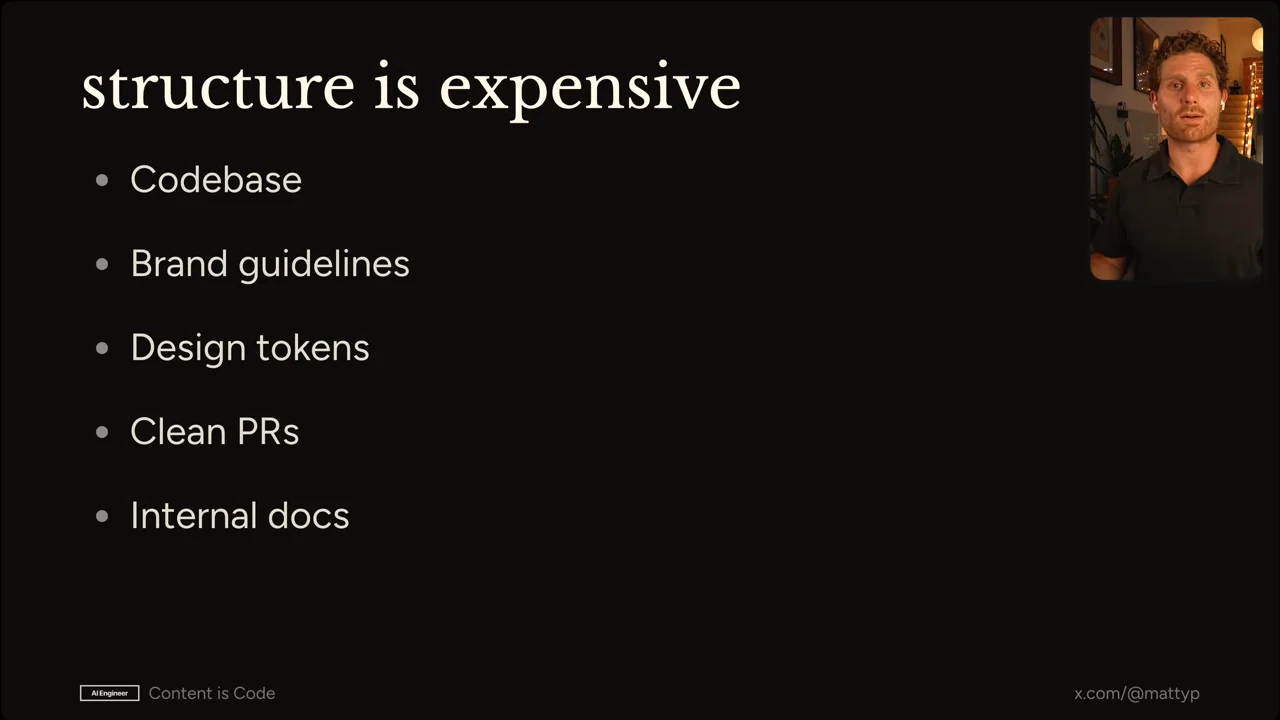
Structure includes the codebase, brand guidelines, design tokens, clean PRs, and internal docs.
These practices support different parts of the output:
| Structured input | What it helps preserve |
| --- | --- |
| Brand guidelines and design tokens | Consistent visual decisions |
| Separated code responsibilities | Clear sources for different concerns |
| PR tags, descriptions, and revert history | An intelligible account of changes |
| Internal documentation and skills | Knowledge needed to perform the task |
Together, they explain the difference Palmer draws between generic AI purple gradients and professional polish: the generated artifact inherits the quality of the material and instructions available to it. He connects that care to conscientiousness.
### Care moves from making to checking
[7:55](https://www.youtube.com/watch?v=yv6xovSsB1U&t=475s)
Conscientiousness means being meticulous, careful, and guided by a sense of moral or professional duty. In this workflow, its practical expression is checking that the outcome matches the intended result. As model capabilities improve, Palmer expects exceptional technical skill to become less decisive than the care given to those expectations and their fulfillment.
That is why he connects AI’s rewards to organizational excellence and structure, including the structure of AI skills themselves. A generated skill is not automatically useful: its contents and organization need attention. Palmer criticizes skills produced without that care, then returns to the assets shown at the beginning. He attributes them to design tokens, structured code, and structured assets, describing production without those inputs as “exponentially harder”—an expression of difficulty, not a quantified scaling result.
### Toward declarative content pipelines
[9:16](https://www.youtube.com/watch?v=yv6xovSsB1U&t=556s)
**Content can move toward the codebase only if the codebase is a structured source of truth.** Moving production upstream does not remove the need for accurate product knowledge, consistent design, or operational instructions. It puts those responsibilities inside the process of creating software. The code can then serve both the product and the communication derived from it.
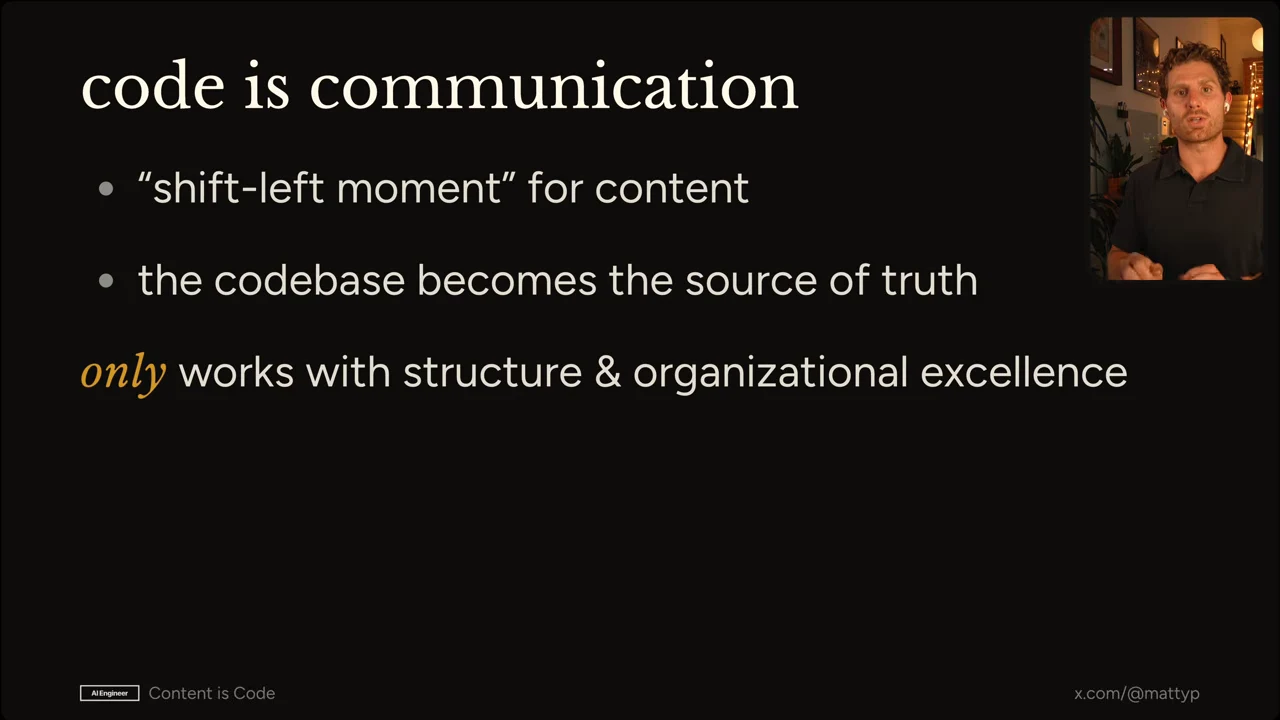
The codebase becomes the source of truth, supported by structure and organizational excellence.
Palmer predicts that the best-communicating teams in 2026 and beyond will be the ones that instill discipline and rigor in software creation and bring content closer to that work. He calls 2026 the year of the creative technologist in DevRel and forecasts 2027 as the year of the **content engineer**. The distinction points toward a more systematic production role: building declarative, robust pipelines that produce walkthroughs, documentation, screenshots, and product updates. Previously manual assets become outputs created through code and React with AI assistance, grounded in the same structured material that defines the product.
## Resources
- [Remotion fundamentals](https://www.remotion.dev/docs/the-fundamentals) — Learn how React components, frame numbers, and composition metadata define a programmatic video.
- [Conductor documentation](https://www.conductor.build/docs) — Introduction to Conductor's coding-agent workspaces and review workflow.
- [Remotion Agent Skills](https://www.remotion.dev/docs/ai/skills) — Official guidance for installing and using Remotion skills with coding agents to create, preview, and render videos.
- [Automatically generated release notes](https://docs.github.com/en/repositories/releasing-projects-on-github/automatically-generated-release-notes) — Generate release summaries from merged pull requests and organize them with labels, categories, and exclusions.
- [Matt Palmer's Remotion and Replit changelog concept](https://www.linkedin.com/posts/matt-palmer_changelog-concept-created-with-remotion-activity-7421749848913272832-S_v7) — Palmer's public post presenting a changelog concept created with Remotion and Replit.
## Slides
### Content is code
The speaker argues that code is increasingly becoming a way to communicate, alongside choices such as blog posts, video, and conference talks.
[0:01](https://www.youtube.com/watch?v=yv6xovSsB1U&t=1s) [Title slide reading “content is code” over green foliage.](https://assets.ai.engineer/sites/aiecode2025/sha256/c15fee27a6fa0d3d55b89d590016b4ec3525fc298ac722ad86ca5417f1900551.webp)
content is code
AI Engineer
https://slides.mattpalmer.io/2026-06-content-is-code/
### Technical communication
Technical communication explains what problem a product solves. It spans docs, changelogs, product marketing email, video, and DevRel—and anyone can do it.
[0:50](https://www.youtube.com/watch?v=yv6xovSsB1U&t=50s) [Slide listing docs, changelogs, product marketing email, video, and DevRel.](https://assets.ai.engineer/sites/aiecode2025/sha256/fd4b54c957aca77937fceb7e000b83868b7e0d3ccc72eec4e9b94064b4b21839.webp)
technical communication
• Docs
• Changelogs
• Email (product marketing)
• Video
• DevRel
AI Engineer
Content is Code
x.com/@mattyp
### Conductor documentation
Conductor’s introduction explains how it runs coding agents in parallel, gives each task its own workspace, and supports review through merging and archiving.
[1:07](https://www.youtube.com/watch?v=yv6xovSsB1U&t=67s) [Conductor introduction documentation describing parallel coding agents and isolated workspaces.](https://assets.ai.engineer/sites/aiecode2025/sha256/8fb3bcf8518c02a7d5d221c6058e16205b2c607349228c4ac963ddd7c28b7eb5.webp)
Introduction
Learn what Conductor is and where to start in the docs
Conductor lets you run Claude Code, Codex, and Cursor in parallel.
Each task gets its own workspace, branch, files, terminal, diff, and review path.
When the work is ready, Conductor helps you review the diff, open a pull request, merge, and archive the workspace.
Interface text:
Introducing Conductor Cloud →
Changelog
Docs
Team
Enterprise
Join Us
Search ⌘ K
Reference
Get Started
Introduction
Install
Your first workspace
Configure your project
Concepts
Isolated workspaces
Workflow
Parallel agents
Testing
Git worktrees
Reference
Workspace setup
Get Started > Introduction
On this pa[illegible]
Get started
Talk to us
Learn more
Embedded video text:
add-themes
add-themes · 13m ago
+297 -2
cbh123-providence
cbh123-providence · 8m ago
ai-finish-choo-sound
Unread · Resear[illegible] how audio/sound[illegible]
+ New workspace
conductor_api
Maintains full compatibility with exi[illegible]
All TypeScript types properly maint[illegible]
The retro theme is now available in the [illegible]
existing Default theme. Users can switc[illegible]
mode preferences with the retro color s[illegible]
### Multiple run scripts
Conductor’s changelog illustrates multiple run scripts with a menu of named options. The speaker notes that an accurate changelog requires an accurate product diff or time spent combing through PRs.
[1:13](https://www.youtube.com/watch?v=yv6xovSsB1U&t=73s) [Conductor changelog entry introducing multiple run scripts, with a run menu pictured.](https://assets.ai.engineer/sites/aiecode2025/sha256/0b61954091bb02166e5942e14873781ed3eee1973504b7ccc1c8a609a85d2b9a.webp)
Multiple Run Scripts
0.70.0
June 26, 2026
Your script is running? You'd better go catch it!
Conductor now supports multiple run scripts - that means you can control all of the commands for your monorepo, tests, and scripts with the "Run" button.
Setup Run Terminal 1 Ter[illegible] +
Run ⌘R
Run
Marketing
Webapp
Internal
Configure
Interface text:
Introducing Conductor Cloud →
Changelog Docs Team Enterprise Join Us
### Conductor product tour
The speaker presents a homepage product tour as an alternative to a static screenshot. Conductor’s homepage pairs its pitch for parallel coding agents with a preview of the app.
[1:47](https://www.youtube.com/watch?v=yv6xovSsB1U&t=107s) [Conductor homepage introduces parallel coding agents above a product tour preview.](https://assets.ai.engineer/sites/aiecode2025/sha256/567da42017bd9aac9de4d62ff32c0e46ac85ff37e11721dfa45574ff297a96ca.webp)
See what's new in 0.69.0 →
CONDUCTOR
Run parallel coding agents on your Mac.
Create parallel Claude Code, Codex, and Cursor agents in isolated workspaces. See at a glance what they're working on, then review and merge their changes.
Download Conductor
Learn how it works →
Show me how Conductor handles this project.
Conductor is a Mac app for running coding agents in parallel. I'll use one isolated workspace for this task: its own branch, files, chat, terminal, preview, and reviewable diff.
1. Send the drafted task.
2. Run the app with ⌘R.
3. Review the diff before you keep it.
Read README.md
Read .conductor/settings.toml
Read src/App.tsx
Add a 10-train milestone animation.
Interface text:
Changelog
Docs
Team
Enterprise
Join Us
Download D
Projects
Quickstart 3
1. Start here +12
2. Run a parallel... +64 -18
3. Next steps +27
Quickstart › 1. Start here
Start here
App.tsx
PR #1432
Ready for review
Create PR
All files
Changes 2
Checks
Review
src/App.tsx
src/App.css
### Claude Code context usage
Claude Code estimates that 127 skills use 21.8k of the 24.6k tokens in context. Its 13 MCP tools are loaded on demand and currently use 0 tokens.
[2:14](https://www.youtube.com/watch?v=yv6xovSsB1U&t=134s) [Claude Code displays context usage and token estimates by category.](https://assets.ai.engineer/sites/aiecode2025/sha256/cb33c9cfdc753f0590af2b76ca566d774564f649970c26c040f96ce56c4d2a34.webp)
/context
Context Usage
Opus 4.8 (1M context)
claude-opus-4-8[1m]
24.6k/1m tokens (2%)
Estimated usage by category
System prompt: 2.7k tokens (0.3%)
Custom agents: 58 tokens (0.0%)
Skills: 21.8k tokens (2.2%)
Messages: 8 tokens (0.0%)
Free space: 975.4k (97.5%)
MCP tools · /mcp (loaded on-demand)
13 tools · 0 tokens
Custom agents · /agents
1 agent · 58 tokens
Skills · /skills
127 skills · 21.8k tokens
/context all to expand
Interface text:
Claude Code v2.1.170
Opus 4.8 (1M context) · Claude Max
~/conductor/workspaces/welcome/tehran
2 setup issues: MCP · /doctor
### Initializing a workspace
In a Conductor product tour recreated with React and Remotion, a sample workspace initializes while dependencies install and the preview waits for setup.
[2:20](https://www.youtube.com/watch?v=yv6xovSsB1U&t=140s) [Conductor initializes a cloud workspace and installs dependencies.](https://assets.ai.engineer/sites/aiecode2025/sha256/e3b5e10c2506e9ece1e5db27fa70ae2347bb5184d14751e9419097bfedd8d1e6.webp)
Set up 4. New workspace and run the Quickstart app once it is ready.
Creating the cloud worktree, installing packages, and preparing the first run script.
Cloud workspace initializing
Initialize cloud workspace
Run setup script
Install dependencies
$ npm install
Creating cloud workspace...
Installing Quickstart dependencies...
Linked Vite preview
Waiting for setup to finish before st[illegible]
preview
Interface text:
Projects
Quickstart 4
1. Start here +12
2. Run a parallel ag... +64 -18
3. Next steps +27
4. New workspace
Quickstart > 4. New workspace
Start here
App.tsx
PR #1432
All files
Setup
Run
Add a follow-up, attach files, or start another agent...
GPT-5.5 Thinking
Fast
High
### Task ready for review
In a React and Remotion recreation of Conductor, a workspace completes a 10-train milestone animation and creates a pull request while the preview runs.
[2:32](https://www.youtube.com/watch?v=yv6xovSsB1U&t=152s) [Conductor shows a completed milestone animation task and a pull request ready for review.](https://assets.ai.engineer/sites/aiecode2025/sha256/b937621339fb378568cfdd19b20a5196e10066bedfccffdb85fb503141b30f01.webp)
Set up 4. New workspace and run the Quickstart app once it is ready.
Creating the cloud worktree, installing packages, and preparing the first run script.
Cloud workspace initializing
Initialize cloud workspace
Run setup script
Install dependencies
Prepare tour preview
Add a 10-train milestone animation.
Done. I added the milestone animation in this workspace, kept the preview running, and left the diff ready to review.
Read src/App.tsx
Update src/App.tsx
Update src/App.css
Run npm run lint
Create a pull request for this workspace.
Created the PR with a focused summary and test notes. The branch is ready for review.
Interface text:
Quickstart > 4. Milestone animation
Start here
App.tsx
PR #1432
Ready for review
All files
Changes 2
Checks
src/App.tsx
src/App.css
Setup
Run
Stop
$ npm run dev
> welcome-to-conductor@0.0.0 dev
> vite
Preview ready
ready in 426ms
watching src/App.tsx and src/App.css
Add a follow-up, attach files, or start another agent...
GPT-5.5 Thinking
Fast
High
### Reviewing the code change
In a recreated Conductor tour, the diff flags every positive count divisible by 10 as a milestone, with a review comment beside the constant. The tour was built with React and Remotion.
[2:35](https://www.youtube.com/watch?v=yv6xovSsB1U&t=155s) [A code diff highlights milestone logic alongside a review comment.](https://assets.ai.engineer/sites/aiecode2025/sha256/e10db5a33338190165bd7cd1d9f813b5c1c9984bf41af38bdf0bbbb3b23d645b.webp)
Edit App.tsx
15 unmodified lines
16 const LANE_COUNT = 5
17 const DISPATCH_THROTTLE_MS = 120
18 const MIN_DURATION_MS = 4500
19 const MAX_DURATION_MS = 7500
20 const MILESTONE_SIZE = 10
Review agent · Jun 24, 1:49 PM
This milestone constant keeps the behavior easy to tune before merge.
22 function App() {
23 const [trains, setTrains] = useState([])
24 const [count, setCount] = useState(0)
25 const [hasDispatched, setHasDispatched] = useState(false)
26 const milestone =
27 count > 0 && count % MILESTONE_SIZE === 0 ? count : undefined
29 const nextIdRef = useRef(1)
30 const lastDispatchRef = useRef(0)
31 const lastLaneRef = useRef(-1)
$ npm run dev
> welcome-to-conductor@0.0.0 dev
> vite
Preview ready
ready in 426ms
watching src/App.tsx and src/App.css
Interface text:
Quickstart > 4. Milestone animation
PR #1432 · Ready for review · PR created
Start here · App.tsx
All files · Changes 2 · Checks
src/App.tsx
src/App.css
Hide · Remove from chat
Setup · Run · Stop
Add a follow-up, attach files, or start another agent...
GPT-5.5 Thinking · Fast · High
### Merged pull request
The recreated Conductor tour ends with the milestone pull request merged, checks passing, and the workspace archived. Matt says the walkthrough is built with React and Remotion and still has bugs.
[2:46](https://www.youtube.com/watch?v=yv6xovSsB1U&t=166s) [Conductor shows the milestone pull request merged, with checks and an archived workspace.](https://assets.ai.engineer/sites/aiecode2025/sha256/837112a1747a4a7827bc222ecb3e2ccdbd8122c10847d0d511b1c3d7406aa688.webp)
Set up 4. New workspace and run the Quickstart app once it is ready.
Creating the cloud worktree, installing packages, and preparing the first run script.
Cloud workspace initializing
Initialize cloud workspace
Run setup script
Install dependencies
Prepare tour preview
Add a 10-train milestone animation.
Done. I added the milestone animation in this workspace, kept the preview running, and left the diff ready to review.
Read src/App.tsx
Update src/App.tsx
Update src/App.css
Run npm run lint
Create a pull request for this workspace.
Created the PR with a focused summary and test notes. The branch is ready for review.
Interface text:
Projects
Quickstart 4
1. Start here +12
2. Run a parallel ag... +64 -18
3. Next steps +27
4. Milestone a... Archived +43
Quickstart > 4. Milestone animation
Start here
App.tsx
PR #1432
Merged
All files
Changes 2
Checks
Add milestone animation
Adds a milestone celebration, keeps the previ[illegible]
and leaves the review comments ready for ch[illegible]
Git status
Merged into main
Deployments
conductor-flow-preview
Checks
lint 14s
build 42s
Preview Live
Your todos
+ Add
Address review comments
Setup
Run
Stop
$ npm run build
> welcome-to-conductor@0.0.0 build
> tsc -b && vite build
dist/index.html 0.48 kB
dist/assets/index.css 4.2 kB
built in 1.1s
Add a follow-up, attach files, or start another agent...
GPT-5.5 Thinking
Fast
High
### Introduction: Matt Palmer
Matt Palmer moved from data engineering to leading DevRel at Replit and developer experience at Conductor. He introduces content shifting left to code as the source of truth.
[2:50](https://www.youtube.com/watch?v=yv6xovSsB1U&t=170s) [Matt Palmer introduces his work as a data engineer, at Replit and at Conductor, alongside his portrait.](https://assets.ai.engineer/sites/aiecode2025/sha256/b78d684e937e9fc129e36a25c72e67354cefc0980337ceedcb180b853f734800.webp)
Hi, I’m Matt
1. data engineer
2. DevRel at Replit
3. DevEx at Conductor
matt palmer
developer experience
CONDUCTOR
AI Engineer
Content is Code
x.com/@mattyp
### Three eras
Matt Palmer maps content through three eras: handcrafted work, expensive code, and today’s cheap code with AI.
[3:16](https://www.youtube.com/watch?v=yv6xovSsB1U&t=196s) [Three eras: handcrafted content, expensive code and cheap code, with the current position marked at cheap code.](https://assets.ai.engineer/sites/aiecode2025/sha256/c21aa5207e4b6a7925a5a215ba20fbd516e427d589b3a0e796dfab4902935bb2.webp)
three eras
• Era 1: handcrafted
• Era 2: code (expensive)
• Era 3: code (cheap) ← you are here
AI Engineer
Content is Code
x.com/@mattyp
### Era 1: handcrafted
In the handcrafted era, content creation is manual. Time, money and skill shape what someone can make, so they may hire an expert or agency to create it.
[3:30](https://www.youtube.com/watch?v=yv6xovSsB1U&t=210s) [The handcrafted era is manual, depends on time, money and skill, and may require paying an agency.](https://assets.ai.engineer/sites/aiecode2025/sha256/5b1458eea846f019e965727c465f51fc3bfdb0c6dfb26899a1f89fa6c02dc8f6.webp)
era 1: handcrafted
• everything is manual
• the only levers are time (money) and skill
If I want it, I’d better pay someone (an agency?)
AI Engineer
Content is Code
x.com/@mattyp
### Era 2: expensive code
With code and cloud mature, engineering became the bottleneck. The speaker argues that paying engineers to build websites left content competing for their time.
[3:46](https://www.youtube.com/watch?v=yv6xovSsB1U&t=226s) [The expensive code era begins with mature code and cloud technology.](https://assets.ai.engineer/sites/aiecode2025/sha256/dd83029e4cde564bd6d33dbf4d075f50103a09c0c442d3d3eb41da75461616a2.webp)
era 2: expensive code
• code and cloud are mature
AI Engineer
Content is Code
x.com/@mattyp
[4:10](https://www.youtube.com/watch?v=yv6xovSsB1U&t=250s) [Slide says code and cloud are mature, engineering is the bottleneck, engineers must be paid, and content is not a priority.](https://assets.ai.engineer/sites/aiecode2025/sha256/7296b9075a9ad9a42c80e1735fc656c49d7179e18635885d6ef79370b4ac1ee7.webp)
era 2: expensive code
• code and cloud are mature
• engineering is the bottleneck
You’d better pay someone (an agency? [struck through] engineer)
content is not a priority
AI Engineer
Content is Code
x.com/@mattyp
### Era 3
Era 3 shifts payment from people to AI providers for video, docs, design and motion graphics. The speaker cautions that quality varies and says understanding the systems helps create high-quality assets.
[4:56](https://www.youtube.com/watch?v=yv6xovSsB1U&t=296s) [Slide lists Claude for video, documentation, design, and motion graphics, and says to pay Anthropic.](https://assets.ai.engineer/sites/aiecode2025/sha256/5cec41978bb96c1f7a2ac52f43ce3d3292cdce0193399835c04fd791ff7487c0.webp)
era 3
• Video: Claude
• Docs: Claude
• Design: Claude
• Motion graphics: Claude
You’d better pay someone [crossed out] Anthropic
AI Engineer
Content is Code
x.com/@mattyp
### Code is communication
The slide crosses out “cheap” to emphasize code as communication. The speaker describes code as a fast way to prototype creative assets, from videos to slides.
[5:29](https://www.youtube.com/watch?v=yv6xovSsB1U&t=329s) [The phrase “code is cheap communication” appears with “cheap” crossed out.](https://assets.ai.engineer/sites/aiecode2025/sha256/e112a1ce895feb90dbf977411d4b8eba69f682af3761a166266df0900a1fe259.webp)
code is cheap communication
AI Engineer
Content is Code
x.com/@mattyp
### Code is communication
The speaker uses React or TypeScript for his presentation’s ancillary assets. He calls TypeScript his favorite medium, a choice he would have found surprising a few years earlier.
[6:06](https://www.youtube.com/watch?v=yv6xovSsB1U&t=366s) [Slide says the fastest way to build an asset is through code, quotes “My favorite medium is TypeScript,” and adds “imagine hearing that in 2024.”](https://assets.ai.engineer/sites/aiecode2025/sha256/cedaa3648dd0370974812c5af5a429b9ee8a3f35a5fdd3f19992907bd4fb1e29.webp)
code is communication
The fastest way to build an asset is through code
“My favorite medium is TypeScript”
imagine hearing that in 2024
AI Engineer
Content is Code
x.com/@mattyp
[6:19](https://www.youtube.com/watch?v=yv6xovSsB1U&t=379s) [Slide says code is the fastest way to build an asset and calls TypeScript the speaker’s favorite medium.](https://assets.ai.engineer/sites/aiecode2025/sha256/fc65859ba2d16e82c2cf34b947b91740bbb1cde152ec0be1c1b3133e3041c538.webp)
code is communication
The fastest way to build an asset is through code
“My favorite medium is TypeScript”
imagine hearing that in 2024
AI Engineer
Content is Code
x.com/@mattyp
### Structure is expensive
Maintaining a structured codebase, consistent brand guidelines, design tokens, clean PRs, and accurate internal documentation takes work. Agents also need documentation or skills to solve problems.
[7:27](https://www.youtube.com/watch?v=yv6xovSsB1U&t=447s) [Slide lists codebase, brand guidelines, design tokens, clean PRs, and internal docs.](https://assets.ai.engineer/sites/aiecode2025/sha256/8ecd7a5d947fb9b616450b44f7bceb4229002d8a9ebe703312e00963ee8e773b.webp)
structure is expensive
• Codebase
• Brand guidelines
• Design tokens
• Clean PRs
• Internal docs
AI Engineer
Content is Code
x.com/@mattyp
### Structure is the difference
The speaker argues that structure often separates AI-generated purple-gradient slop from professional, polished work.
[7:39](https://www.youtube.com/watch?v=yv6xovSsB1U&t=459s) [The phrase “structure is the difference” appears in a glowing purple box.](https://assets.ai.engineer/sites/aiecode2025/sha256/c544a97240962f6e3a04100a50725a9aee251b1afc57e9ddfb6465dde41c1684.webp)
structure is the difference
AI Engineer
Content is Code
x.com/@mattyp
### Conscientiousness
The speaker argues that meticulous care in making an outcome match expectations matters more than the technical skill needed to create the assets.
[7:51](https://www.youtube.com/watch?v=yv6xovSsB1U&t=471s) [Definition of conscientiousness as being meticulous, careful, and guided by a sense of moral or professional duty.](https://assets.ai.engineer/sites/aiecode2025/sha256/242817c70312af7cfa9f5535b5f16b4006f839c8c7a3dfdd303f2a9878096234.webp)
conscientiousness
/ˌkɑːn.ʃiˈen.ʃəs.nəs/
1. the quality of being meticulous, careful, and guided by a strong sense of moral or professional duty.
AI Engineer
Content is Code
x.com/@mattyp
### AI rewards
The speaker argues that good AI skills depend on conscientiousness, organizational excellence, and structure. Generated skills can fall short when their contents and structure receive little care.
[8:37](https://www.youtube.com/watch?v=yv6xovSsB1U&t=517s) [Slide lists conscientiousness, organizational excellence, and structure, followed by the word skills.](https://assets.ai.engineer/sites/aiecode2025/sha256/e0fe2ba9f729e39cdcd8c2655ab75e0c04ec47e5c5ba195751d339acbabeb4e1.webp)
ai rewards
• conscientiousness
• organizational excellence
• structure
skills
AI Engineer
Content is Code
x.com/@mattyp
### Code is communication
Moving content into code makes the codebase its source of truth. Creating content from it depends on structure and organizational excellence.
[9:42](https://www.youtube.com/watch?v=yv6xovSsB1U&t=582s) [Slide says content is shifting left, the codebase becomes the source of truth, and this only works with structure and organizational excellence.](https://assets.ai.engineer/sites/aiecode2025/sha256/ee5b081eecbfa814211ea9afe36c2293a923ce24151e10683f36edfddb200f96.webp)
code is communication
• ”shift-left moment” for content
• the codebase becomes the source of truth
only works with structure & organizational excellence
AI Engineer
Content is Code
x.com/@mattyp
### 2026: year of the creative technologist
The speaker calls 2026 the year of the creative technologist in DevRel, a term he says was widely used.
[10:11](https://www.youtube.com/watch?v=yv6xovSsB1U&t=611s) [Slide reads, 2026: year of the creative technologist.](https://assets.ai.engineer/sites/aiecode2025/sha256/863f98b90baeb3296aa4b0bc195457b61bd9bf8b07c45ba53bc74f5a4fbd9daa.webp)
2026: year of the creative technologist
AI Engineer
Content is Code
x.com/@mattyp
### 2027: year of the content engineer
Matt predicts that 2027 will bring declarative content pipelines capable of producing walkthroughs, documentation, screenshots, and product updates.
[10:19](https://www.youtube.com/watch?v=yv6xovSsB1U&t=619s) [Slide reads, 2027: year of the content engineer.](https://assets.ai.engineer/sites/aiecode2025/sha256/f86c60c227739b9adb7c073bbe07194fd9aff24bab4b1d5c665d37c039d700bb.webp)
2027: year of the content engineer
AI Engineer
Content is Code
x.com/@mattyp
## Full transcript
[0:00](https://www.youtube.com/watch?v=yv6xovSsB1U&t=0s) So if you've ever created content, you know it can be hard. And what's often most hard is choosing a medium for how you'd like to communicate. Do you write a blog post?
[0:09](https://www.youtube.com/watch?v=yv6xovSsB1U&t=9s) Do you create a video? Do you go out and speak at a conference? And even of these things, you're likely to select something that you're good at or you have experience doing.
[0:17](https://www.youtube.com/watch?v=yv6xovSsB1U&t=17s) But the idea I want to present to you today is that increasingly, code is becoming the way that we communicate. Now, this might seem obvious in twenty twenty-six, but I want to point out that even a couple of years ago, this was wild because the only people that were writing code to create content were professional software engineers.
[0:34](https://www.youtube.com/watch?v=yv6xovSsB1U&t=34s) And often, professional software engineers are spending their time doing mostly engineering and are not getting that deep on content. Now, what do I mean when I say content? Well, I'm talking mostly about technical communication, and that could be documentation, it could be things like changelogs, emails, product marketing.
[0:51](https://www.youtube.com/watch?v=yv6xovSsB1U&t=51s) It could be video, which I create a lot of. Um, and it could be other things associated with a typical DevRel motion, but it's not restricted to DevRel, right?
[1:00](https://www.youtube.com/watch?v=yv6xovSsB1U&t=60s) Content or technical communication is the act of communicating what a, what problem a product really solves, and that can be done by anybody. That might mean really complete accurate documentation that covers every part of the data access framework.
[1:14](https://www.youtube.com/watch?v=yv6xovSsB1U&t=74s) It could be changelogs shipped timely, um, with robust assets that cover all areas of a product. This is something that's often overlooked. This is actually really hard because to have an accurate changelog, you have to have an accurate diff of your product.
[1:28](https://www.youtube.com/watch?v=yv6xovSsB1U&t=88s) Or you could just have someone that spends a lot of their time combing through PRs to try to figure out what was shipped. It could be things like timely product updates, emails which kind of follow from a changelog, right?
[1:40](https://www.youtube.com/watch?v=yv6xovSsB1U&t=100s) If you understand what changed, you can then summarize that over time for your users. It could be something as simple as a homepage product tour instead of a static screenshot.
[1:53](https://www.youtube.com/watch?v=yv6xovSsB1U&t=113s) These are all ways that we're communicating products. We're communicating what this thing does or how it's changed via either written content, um, uh, free-- via code, via distinct assets.
[2:09](https://www.youtube.com/watch?v=yv6xovSsB1U&t=129s) It could also be something like video overlays, right? Something like, uh, adding a bit of, um, engaging material to the content that you create. But increasingly, where I think this is headed is entire product surfaces and entire videos generated via code.
[2:26](https://www.youtube.com/watch?v=yv6xovSsB1U&t=146s) And in front of me, I have a product tour for Conductor that was built entirely with React and Remotion. So basically, I recreated the product surface. I used a Remotion scene to recreate the product and do a full walkthrough, um, of a sample user flow.
[2:43](https://www.youtube.com/watch?v=yv6xovSsB1U&t=163s) Now, it's not perfect, it's a little buggy, and the flows aren't quite there yet, if I'm being honest, but I think we're moving towards a world where this is normal.
[2:52](https://www.youtube.com/watch?v=yv6xovSsB1U&t=172s) So my name is Matt. I was previously a data engineer, then I led DevRel at Replit, and now I lead developer experience at Conductor. And today, I wanna talk about how content is shifting left to code as the source of truth.
[3:07](https://www.youtube.com/watch?v=yv6xovSsB1U&t=187s) And so I think there are three distinct eras we can think about here. Era one, the handcrafted era of content. Era two, an era where code existed, but it was quite expensive.
[3:17](https://www.youtube.com/watch?v=yv6xovSsB1U&t=197s) And era three, where code exists, but it's very cheap, and that's where we are today with AI. So in the handcrafted era, right, everything is manual. The only levers we really have are time and money and skill.
[3:31](https://www.youtube.com/watch?v=yv6xovSsB1U&t=211s) And so if I want something, I either need to create it myself, but there are only twenty-four hours in a day, so likely I'm gonna go out and seek an expert, someone that does know how to create this thing.
[3:40](https://www.youtube.com/watch?v=yv6xovSsB1U&t=220s) Maybe that's an agency or someone who creates these assets professionally, if I'm thinking about, like, motion graphics, for example. Now, post era one, when we had expensive code, code and cloud are mature assets.
[3:55](https://www.youtube.com/watch?v=yv6xovSsB1U&t=235s) These are things that have existed for a while and most professional software engineers know how to use. Engineering is now the bottleneck. This is like ZIRP era. Everybody's paying a lot for engineers, and to get anything done, you really need professional software engineers.
[4:11](https://www.youtube.com/watch?v=yv6xovSsB1U&t=251s) So you'd better pay someone, maybe not an agency, but an engineer. And that included things like, you know, um, robust documentation or even just a website, right? You-- Back in the day, it's hard to imagine before AI, you wanted a website, a good website, you needed a front-end engineer or, like, a low-code website service, but those weren't
[4:29](https://www.youtube.com/watch?v=yv6xovSsB1U&t=269s) any good to begin with. So you needed a professional engineer to have a really nice website. And what that meant was that content is really not the priority, right?
[4:38](https://www.youtube.com/watch?v=yv6xovSsB1U&t=278s) Because if you're a professional engineer, you have better ways of spending your time. And I think this is reflected by, um, libraries like Remotion, frameworks like Remotion, um, not proliferating the way that they are today.
[4:51](https://www.youtube.com/watch?v=yv6xovSsB1U&t=291s) Because really, who has the time and energy to put into these things? There aren't a ton of what I'd call content engineers. Now, in era three, most of these things, you're not paying a human, you're paying Anthropic or OpenAI or whoever, right?
[5:05](https://www.youtube.com/watch?v=yv6xovSsB1U&t=305s) You can create videos with Claude. You can create documentation with Claude. You can design websites with Claude, and you can create motion graphics with Claude. Now, the problem is that none of the-- not all of these things are good, right?
[5:16](https://www.youtube.com/watch?v=yv6xovSsB1U&t=316s) We'll talk about that later. But if you know what you're doing, if you have an engineering mindset, if you understand the systems, you can create high-quality assets with these systems.
[5:24](https://www.youtube.com/watch?v=yv6xovSsB1U&t=324s) And I'm gonna talk about how to do that in the rest of this presentation. So today, code is cheap, and we talk about code as communication. So code is communication.
[5:36](https://www.youtube.com/watch?v=yv6xovSsB1U&t=336s) The fastest way to build an asset today is through code. And it's not just to build software, right? It's really to build anything. If I want to prototype a video, a website, slides, um, I mean, really any asset, any creative thing that I can think of, images, video, the fastest way to do that is gonna be through
[5:58](https://www.youtube.com/watch?v=yv6xovSsB1U&t=358s) code or code generation. And I was thinking about this presentation. I was thinking about how I was going to create all the assets for this presentation, and I realized that my favorite medium is actually TypeScript.
[6:10](https://www.youtube.com/watch?v=yv6xovSsB1U&t=370s) Aside from recording myself talk or writing, every ancillary asset is React or TypeScript. And I just want to take a moment because that is the most insane statement to hear myself say if I was thinking about this two or three years ago, right?
[6:26](https://www.youtube.com/watch?v=yv6xovSsB1U&t=386s) I don't even really know [chuckles] how to write that good of TypeScript, you know. My background's in data engineering. I come from Python land. Well, I better learn TypeScript. I better learn React because the best way for me to get these high-fidelity assets is React, TypeScript, CSS, um, and HTML, and that's wild.
[6:44](https://www.youtube.com/watch?v=yv6xovSsB1U&t=404s) That's wild to say. So if code is inexpensive, what is the expensive thing? Now, you might think I'm gonna say taste here. I'm not gonna say taste because everybody says taste.
[6:53](https://www.youtube.com/watch?v=yv6xovSsB1U&t=413s) Structure is expensive. This is maybe a bit of a contrarian set- statement here because the hard thing is maintaining a very structured code base, maintaining brand guidelines and keeping those guidelines consistent, keeping design tokens in your project, separating even front-end code from back-end code from these design tokens.
[7:15](https://www.youtube.com/watch?v=yv6xovSsB1U&t=435s) Merging really clean PRs, which, like, nobody does, right? Tagging PRs, PR descriptions, knowing what's a feature and what's a bug fix, knowing if you reverted a PR. How many organizations do this?
[7:25](https://www.youtube.com/watch?v=yv6xovSsB1U&t=445s) I've worked at a number of organizations. None, right? And maintaining accurate internal documentation so that anybody can accomplish anything. Even if you have really good agents, they're not gonna know how to solve these problems if they don't have documentation or skills, right?
[7:40](https://www.youtube.com/watch?v=yv6xovSsB1U&t=460s) And so structure often is the difference between AI purple gradient slop, right, and something that looks professional and polished. And I would even go a little bit further and I would say that this is conscientiousness.
[7:55](https://www.youtube.com/watch?v=yv6xovSsB1U&t=475s) And the dictionary of definition for conscientiousness is the quality of being meticulous, careful, and guided by a strong sense of moral or professional duty. And so it's less about comp-- like software engineering skill today.
[8:09](https://www.youtube.com/watch?v=yv6xovSsB1U&t=489s) It's less about the skill of being able to create these, these assets and more about the meticulousness and care given to making sure that an outcome matches your expectations.
[8:23](https://www.youtube.com/watch?v=yv6xovSsB1U&t=503s) And that, you know, increasingly with each model generation is not predicated on being the smartest person in the room or being the s- the person in the room with the most technical skill.
[8:34](https://www.youtube.com/watch?v=yv6xovSsB1U&t=514s) So what does AI reward? AI rewards conscientiousness. AI rewards organizational excellence. AI rewards structure. And ultimately, these are the things that go into good AI skills.
[8:51](https://www.youtube.com/watch?v=yv6xovSsB1U&t=531s) There's a lot of, like, not very good AI skills out there. Um, and most of them are just generated without any regard for what's in their contents or, or how they're structured.
[9:01](https://www.youtube.com/watch?v=yv6xovSsB1U&t=541s) And so all the assets that I showed you at the beginning of this video are a byproduct of design tokens, structured code, um, structured assets, and they get exponentially harder to create when we lack those things.
[9:16](https://www.youtube.com/watch?v=yv6xovSsB1U&t=556s) And so code, again, is communication, and we're seeing a shift left movement for content where content is moving to code. And if code, right, is the source of truth, if our code base is the source of truth, we have to have a structured source of truth in order to create content from code.
[9:37](https://www.youtube.com/watch?v=yv6xovSsB1U&t=577s) In order to communicate, we need structure and conscientiousness around the way that we create code. And again, this only works with organizational excellence. And so I think what we'll see in twenty twenty-six and the years beyond is that the highest performing, the best communicating teams are the ones that are able to instill discipline and rigor
[10:01](https://www.youtube.com/watch?v=yv6xovSsB1U&t=601s) into the process of creating software and then shift their content left towards the code through content engineering. And so twenty twenty-six, I think, was the year of the creative technologist, at least in the DevRel space.
[10:18](https://www.youtube.com/watch?v=yv6xovSsB1U&t=618s) This is the term that got thrown around a lot. I think twenty twenty-seven is the year of the content engineer, and I'll close on that because I think what we're gonna see next year are declarative and robust content pipelines capable of producing content walkthroughs, capable of producing documentation, screenshots, product updates.
[10:38](https://www.youtube.com/watch?v=yv6xovSsB1U&t=638s) All of the things that were really manual can now be created through code, through React, and ultimately because of AI. Again, I'm Matt with Conductor. Thanks for sticking around for my talk.
[10:51](https://www.youtube.com/watch?v=yv6xovSsB1U&t=651s) I'll catch you next time. Peace.