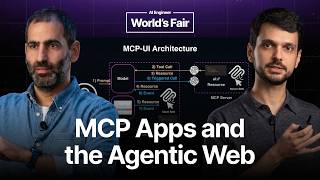
MCP Apps: Extending the Frontier — Ido Salomon & Liad Yosef
AI Engineer World's Fair 2026 · 18:38

AI application interface protocol and SDK
MCP Apps extends the Model Context Protocol so tools can return interactive interfaces inside AI conversations. It is a protocol project, not a standalone company. Developers use its specification and ext-apps SDK to build dashboards, forms, document viewers and other interfaces for compatible hosts. Users can explore data, configure deployments, review documents and monitor live metrics without leaving the conversation. The SDK supports app developers, server authors and developers embedding these interfaces in AI clients.
Launched as an official extension in 2026, MCP Apps standardized patterns developed in MCP-UI and the OpenAI Apps SDK through collaboration with OpenAI and Anthropic. MCP-UI creators Ido Salomon and Liad Yosef lead the MCP Apps Working Group alongside Olivier Chafik. Its technical contribution is a shared contract: tools declare HTML interface resources, hosts render them in sandboxed iframes, and bidirectional JSON-RPC messaging carries tool results and user interactions. This keeps interfaces connected to the conversation while letting hosts control permissions.
In June 2026, co-creator Ido Salomon described an ecosystem of hundreds of apps, while identifying end-user discovery as an unresolved challenge. Supported hosts include Claude, VS Code GitHub Copilot, Microsoft 365 Copilot and Goose.
This guide covers the supplied MCP Apps recording catalog: one talk by Liad Yosef. The paths below lead into different parts of that recording. They describe the speaker’s recorded arguments and reports, not verified facts about current products, adoption or standards.
Watch Rebuilding the web for agents for Yosef’s vision of assistants composing small service interfaces inside chat. He presents MCP Apps as a way to preserve provider identity and human choice when people still need to inspect or select something. His “nearly headless web” argument is useful for thinking about which interactions an assistant could handle and which still benefit from visible controls.
Return to the same talk for a broader account of agent readiness: understanding, authentication, action and payment alongside discovery. Yosef contrasts browser automation and co-browsing with direct agent access. His account of switching from Mixpanel to PostHog illustrates his argument that agent integration friction can influence tool selection; it does not establish a general comparison of those products.
Use Yosef’s discussion of ORA to explore how agents find guidance and machine-usable resources. He reports agents reaching documentation and homepages rather than independently seeking llms.txt, introduces ORA Journey and ORA.directory, and discusses catalogs and resource discovery. The supplied summary flags an internally inconsistent numerical account, so treat this material as a prompt to observe behavior across harnesses rather than as a reliable quantitative benchmark. His closing accessibility argument connects usable nonvisual signals with both human and agent access.
AI Engineer World's Fair 2026 · 18:38
Affiliations reflect their AIE appearances, not necessarily current employment.